Friday 12th April 2019 (b)

BUBO in ESPAÑA - part 3

After a very successful morning driving the Santa Marta de Magasca loop and me ticking off no less than four new species, we thought it was a good opportunity to stop for a breather and some food. We took the main road towards Cacares before slipping off to get petrol. As we took the roundabout of the junction we noticed a superb Egyptian Vulture just sat in a field to the north of the road. We wanted to get a better look and ended up circling the roundabout four times before we found a break in the traffic to stop.
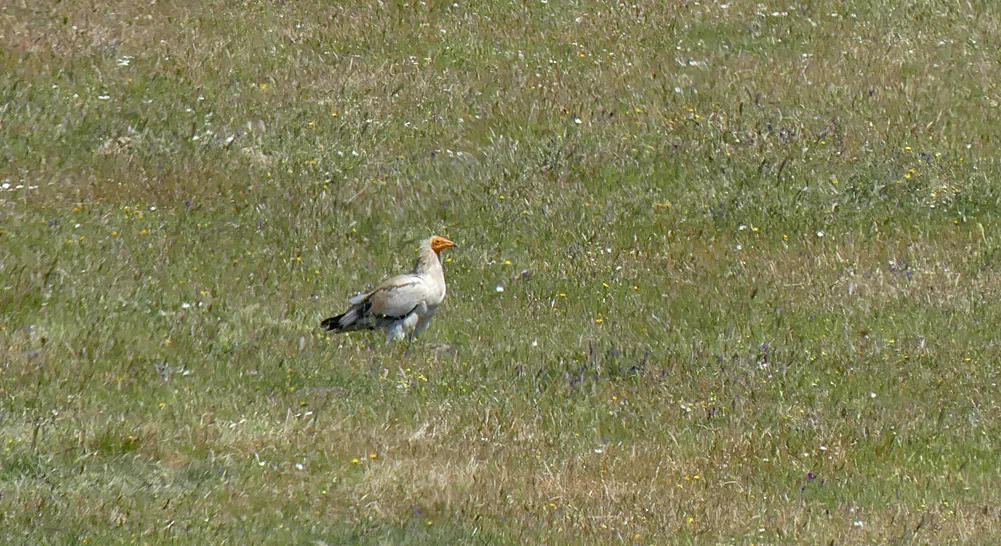
Egyptian Vulture - E of Cacares, 12 Apr 19

Egyptian Vulture - E of Cacares, 12 Apr 19

Next to the petrol station there was a café and we went in for some grub. As was to be a theme, the vegetarian options weren’t exactly wide ranging and I had a Spanish omelette. My diet for the week would more or less be just eggs, potato and bread. When birding in Europe you’ve always got to take into account that ordering and eating food takes quite a long time. Ideally you’d like to just grab a quick bite to eat and then be out in the field again as soon as possible. In Spain we found that even a quick stop for food was a drawn-out process if you had to place an order. After we’d finished we headed back to the car and noticed that there were quite a few moths sitting on the shady, white wall of the petrol station - obviously there was an overnight security light there. There were lots of the micro Ethmia bipunctella and a few other pyralids, a shark moth which looked like Chamomile Shark (but there are a few very similar species) and a white-coloured footman that we subsequently worked out must have been a plain form of Speckled Footman. Then Andy looked up and saw a huge monster of a moth, as big as your hand, on the overhang. This was a Great Peacock Moth, one of the biggest moths in Europe, a giant version of an Emperor Moth. It was a real beast.

Great Peacock Moth - E of Cacares, 12 Apr 19

Great Peacock Moth - E of Cacares, 12 Apr 19

Speckled Footman - E of Cacares, 12 Apr 19

Speckled Footman - E of Cacares, 12 Apr 19

Chamomile Shark (or similar species) - E of Cacares, 12 Apr 19

Chamomile Shark (or similar species) - E of Cacares, 12 Apr 19

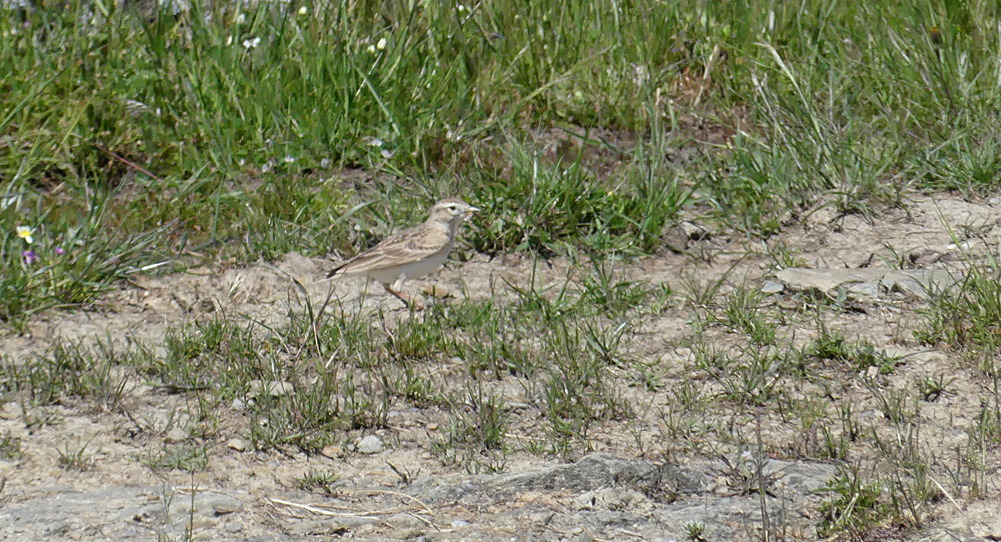
As we’d been very successful in the morning, we didn’t really have any more specific targets to look for in the plains, so we thought we’d try a different area. The guide book said that the plains south of Cacares were pretty good and so we headed down there. We got delayed in the traffic in Cacares town centre but it meant we were able to see some urban swifts above the streets which we guessed were probably Pallid Swifts. About 10 km south of Cacares is the village of Valdesalor and from there we turned west along a dirt track into the plains. At the start of the track, after we crossed a rickety bridge, there were a few ponds where we saw a couple of Little Grebes and a few Fan-tailed Warblers were zitting away. We carried on through the quite dusty and barren habitat but there didn’t seem a lot of birds in this area, although it was now the middle of the day and it was getting warm out. We stopped the car at the top of the first hill so we could scan the area. There wasn’t a great deal to see flying around apart from a few vultures and White Storks. In a large ploughed field there were quite a few Short-toed Larks singing and feeding. We had a few Meadow Pipits and a Wheatear but we pushed on to find a better area.

Valdesalor Plains, 12 Apr 19
Valdesalor Plains, 12 Apr 19

Short-toed Lark - Valdesalor Plains, 12 Apr 19

Short-toed Lark - Valdesalor Plains, 12 Apr 19

White Stork - Valdesalor Plains, 12 Apr 19

White Stork - Valdesalor Plains, 12 Apr 19

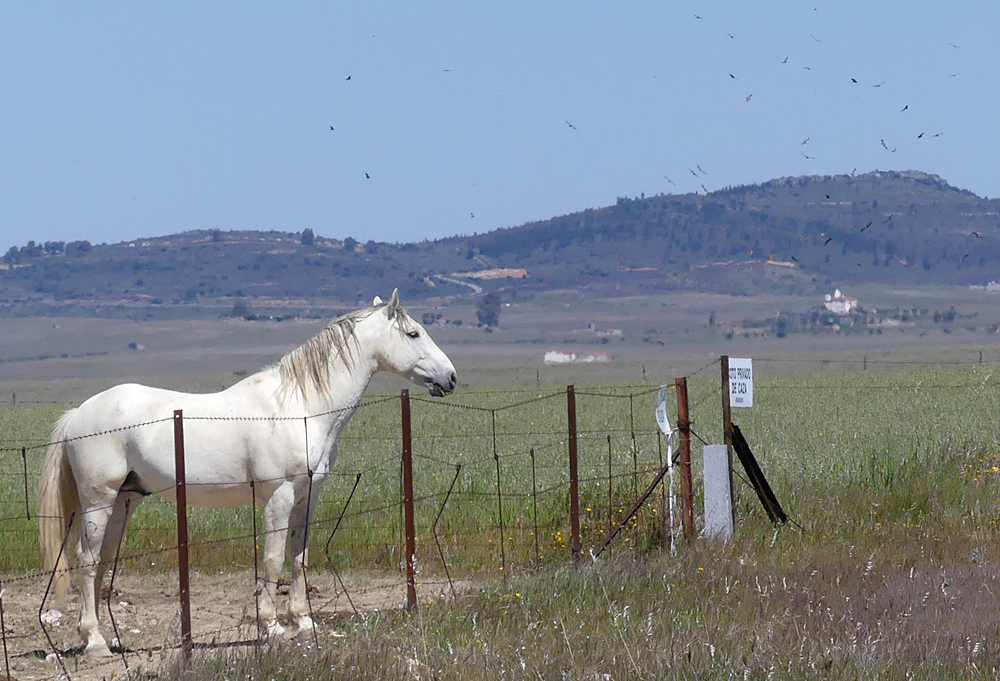
The track wound its way up the next hill and it became a little bit rough with rocks sticking out from the ground. There was a strong chance of undercarriage problems but Ian skilfully avoided any damage - just. Ahead, we could see a large flock of Griffon Vultures circling, perhaps as many as 100 or so. We headed towards these and, over the next rise we got a bit closer. It was quite spectacular watching such a large flock of such a large species. We found at least one, probably two, Black Vultures in amongst these but the heat haze and the distance meant that the species was still avoiding the camera. We had more Short-toed Larks along the track, along with the odd Woodchat Shrike and Spanish Sparrow flock. Later on, as the track dropped back down towards the next main road we found a very distant Great Bustard in a field. Despite our best efforts, we didn’t find half as much in these plains as we had in the Santa Marta area, but it may have been linked with the time of day.
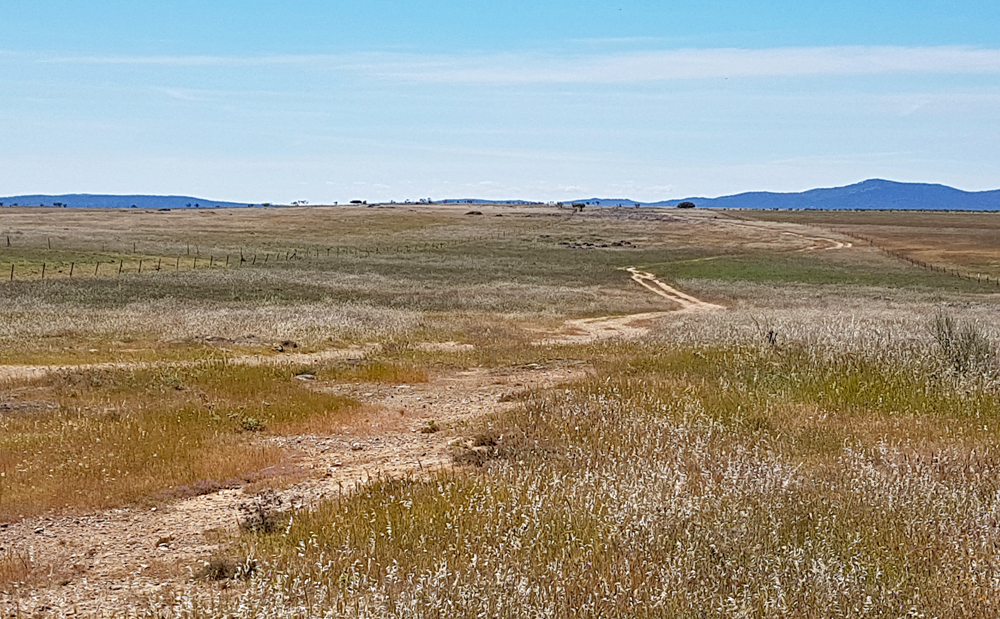
The track we followed crossing the Valdesalor Plains, 12 Apr 19

The track we followed crossing the Valdesalor Plains, 12 Apr 19

Griffon Vultures - Valdesalor Plains, 12 Apr 19

Griffon Vultures - Valdesalor Plains, 12 Apr 19

Barbary Nut Iris - Valdesalor Plains, 12 Apr 19

Barbary Nut Iris - Valdesalor Plains, 12 Apr 19

Small Heath - Valdesalor Plains, 12 Apr 19
Small Heath - Valdesalor Plains, 12 Apr 19

Griffon Vultures and horse - Valdesalor Plains, 12 Apr 19

Griffon Vultures and horse - Valdesalor Plains, 12 Apr 19

When we reached the next main road, we headed further SW until we reached the edge of the plains and the road rose towards a rocky escarpment which was apparently a traditional Eagle Owl site. We didn’t expect to see one of course in the daytime but we thought it was a decent place to have a bit of a stroll in a bit of a different habitat. This area was much more bushy dominated by Gum Cistus with its large white flowers. The best bird here was a Dartford Warbler which was elusive but eventually showed briefly. The warm weather had brought the lepidoptera out and we saw a few species of butterfly including a Green Hairstreak and a rather splendid geometer moth, Lythria sanguinaria, which had purple stripes and a bright orange hindwing.

Short-toed Eagle - SW of Valdesalor Plains, 12 Apr 19

Short-toed Eagle - SW of Valdesalor Plains, 12 Apr 19

Gum Cistus - SW of Valdesalor Plains, 12 Apr 19

Gum Cistus - SW of Valdesalor Plains, 12 Apr 19

Lythria sanguinaria - SW of Valdesalor Plains, 12 Apr 19

Lythria sanguinaria - SW of Valdesalor Plains, 12 Apr 19

As it was now getting well into the afternoon, we thought it might be worth retracing our steps this morning and heading back to the Santa Marta de Magasca loop. We saw quite a few more Little Owls on the Roller nestboxes but didn’t really stop until we got to the same bridge west of the village that we visited earlier. We didn’t see any different birds here, although the Crag Martins were putting on quite a show, chasing each other around. The best thing here though was the snake that Daniel spotted swimming through the water. From the bridge I could see it really well as it swam underneath and out the other side. We identified it as a Viperine Snake from the zigzag pattern on top and the white spots down the side. This is in the same genus as Grass Snake and is similarly very aquatic, this one probably hunting frogs. Whilst watching this one we saw two smaller ones in the water. I was thrilled with this - I never get to see any snakes!

Viperine Snake - West of Santa Marta de Magasca, 12 Apr 19

Viperine Snake - West of Santa Marta de Magasca, 12 Apr 19

Viperine Snake - West of Santa Marta de Magasca, 12 Apr 19

Viperine Snake - West of Santa Marta de Magasca, 12 Apr 19

Viperine Snake - West of Santa Marta de Magasca, 12 Apr 19

Viperine Snake - West of Santa Marta de Magasca, 12 Apr 19

Crag Martins - West of Santa Marta de Magasca, 12 Apr 19

Crag Martins - West of Santa Marta de Magasca, 12 Apr 19

We found the track that we had visited first thing this morning to see if the bustards were showing any closer. We did see a couple of the Great Bustards but they were again pretty far away on the crest of the hill. Most of the birds we saw were similar to this morning - we did have a calling Quail however. We thought it was worth stretching our legs for a walk up one of the tracks to see what we could see and maybe get closer to the bustard. We could not however and the main areas of interest were non-avian. A fritillary on the track revealed itself to be a Queen of Spain Fritillary with its white underwing spots and curved forewing. We photographed a yellow-coloured dragonfly which we eventually identified as a Western Clubtail. We couldn’t work it out at first especially as this species barely has a clubbed tail at all. Just as we returned to the car I saw a large lizard race across the track and hurl itself over a dry stone wall. I didn’t get a good look at it and it was impossible to refind, but from size alone it had to be an Ocellated Lizard.
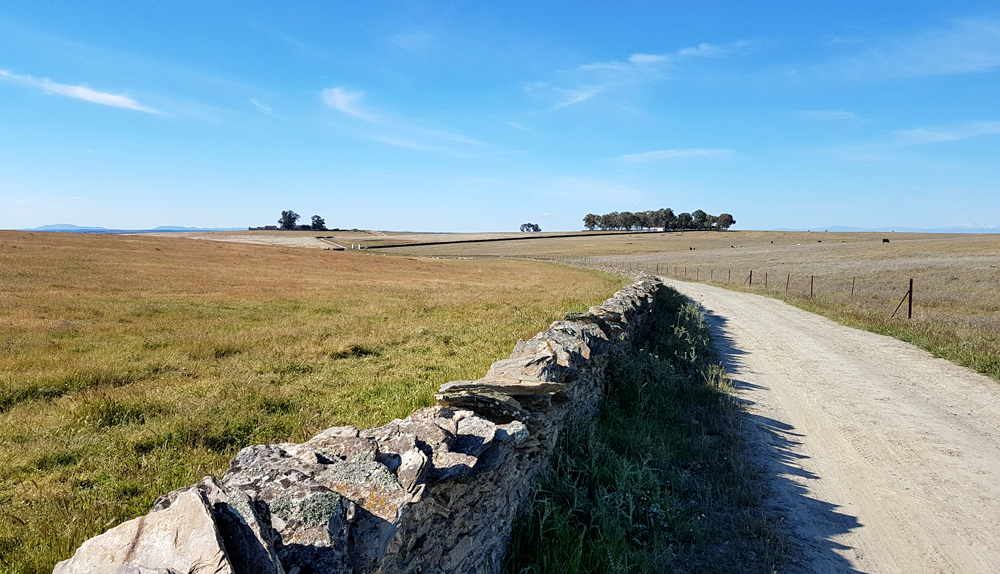
SE of Santa Marta de Magasca, 12 Apr 19

SE of Santa Marta de Magasca, 12 Apr 19

Queen of Spain Fritillary - SE of Santa Marta de Magasca, 12 Apr 19

Queen of Spain Fritillary - SE of Santa Marta de Magasca, 12 Apr 19

Western Clubtail - SE of Santa Marta de Magasca, 12 Apr 19

Western Clubtail - SE of Santa Marta de Magasca, 12 Apr 19

Red-striped Oil Beetle and a smorgasbord of lichens - SE of Santa Marta de Magasca, 12 Apr 19

Red-striped Oil Beetle and a smorgasbord of lichens - SE of Santa Marta de Magasca, 12 Apr 19

Walking back down the track SE of Santa Marta de Magasca, 12 Apr 19

Walking back down the track SE of Santa Marta de Magasca, 12 Apr 19

Driving out of the area, before we got to the main road, we saw a small flock of birds fly across the road in front of us. They gave the impression that they may have been sandgrouse and appeared to land in a field. So we pulled up and climbed the bank to look in the field but all we saw were sheep. However, just in the field next door we were surprised to see a super Great Bustard, much closer than any we had seen earlier. It seemed to suddenly appear from nowhere so may have been sat down in the long grass before spotting us. Really I should have got better photos before it wandered off over the rise.

Great Bustard - SE of Santa Marta de Magasca, 12 Apr 19

Great Bustard - SE of Santa Marta de Magasca, 12 Apr 19

As with the previous day, I had now developed a stinker of a headache and the painkillers I had taken a short while before hadn’t helped at all. It’s more annoying than anything when you just want to enjoy your time away and your head is distracting you. We headed off for some food at a roadside eatery - well when I say food, I mean a strange “vegetable burger” of various salad things and eggs, with much ‘gunk’ upon it - not very pleasant. Outside we noticed that the juvenile Swallows here had already left the nest from the colony in the car park. Also in the car park we found a flattened Sardinian Warbler that had probably fallen off someone’s front grill, and also a dead Spanish Marbled White lying on the floor.

Spanish Marbled White (deceased) - near Trujillo, 12 Apr 19

Spanish Marbled White (deceased) - near Trujillo, 12 Apr 19

We took the back roads back to Plasenzuela after we had eaten and finally came across an Azure-winged Magpie that stood still for a minute. The species is relatively common it seems but nearly always only seen in flight. This was the only opportunity I had all holiday to take a snap. But a cracking bird nonetheless. After doubling up on paracetamol and having a lie down in the room I suddenly felt a lot better and was finally able to enjoy a nice beer with the lads in the bar. Loooooooooog!!!

Azure-winged Magpie - nr Plasenzuela, 12 Apr 19

Azure-winged Magpie - nr Plasenzuela, 12 Apr 19

Our route for the day

Our route for the day

Friday 12th April 2019 (a)

BUBO in ESPAÑA - part 2

As we were all so very tired last night we decided that it wasn’t necessary to get up at the crack of dawn to get out birding at first light and that we’d take it easy and have some breakfast in the hotel. This I was especially pleased with, because it meant that I could make sure got rid of my bad head and be (hopefully) fresh for the first full day in the field. We woke up in plenty of time, just as it was getting light and looked out from the hotel room balcony where there was a bit of an un-Spanish-like chill in the air and I felt fine. Nevertheless we could hear a Hoopoe singing and there was a group of Red-rumped Swallows feeding around the yard below. Even better, we saw a few Azure-winged Magpies swooping through some gardens to our left, clearly a pretty common bird round here. We moseyed on down to grab some breakfast and were keen to eat and run to get out in the field. But we had forgot that eating was quite a pedestrian pastime in these parts and they weren’t going to hurry. Eventually, well after half eight we set off north out of Plasenzuela, a little bit part-time but we didn’t mind.

We decided that on our first day, we would concentrate on the birds of the wide open plains that surround the town of Cacares. We crossed the main road between Cacares and Trujillo and carried on NW on a minor road towards the village of Santa Marta de Magasca. We had mostly been driving through open oak woods but after a short while driving down this minor road the landscape opened up. The gentle hillsides, especially on the east side of the road were covered in vast fields of short grassland, broken intermittently by fences and stone walls. This was big country.

The first decent bird we saw here was a ringtail Montagu’s Harrier quartering the field just in front and close to the road. We tried to get a little bit closer for a better look but it was flying away from us. However, when we stopped the car on the road to watch, we soon lost interest in the raptor. Breaking the horizon on top of the hillside to our right, strutting around like a boss, was a big, bad, GREAT BUSTARD! We found a more suitable pull-in and got the ‘scopes out of the boot and enjoyed good views - another new species for me. It was posing quite nicely albeit at the top of the hill so we couldn’t get any good photos. In fact, photography in the plains was very difficult in general as the birds were never exactly close. The orange in the plumage was really bright and the tail was regularly fanned. You could even make out the fancy whiskers. Probably my number one target bird in the plains and we’d seen one within minutes.

Watching our first Great Bustard SE of Santa Marta de Magasca, 12 Apr 19

Watching our first Great Bustard SE of Santa Marta de Magasca, 12 Apr 19

Great Bustard - SE of Santa Marta de Magasca, 12 Apr 19

Great Bustard - SE of Santa Marta de Magasca, 12 Apr 19

Great Bustard - SE of Santa Marta de Magasca, 12 Apr 19

Great Bustard - SE of Santa Marta de Magasca, 12 Apr 19

In the grass between us and the bustard we could see a few Calandra Larks appearing and disappearing into the vegetation. Resting on a grass head next to us was a fabulous Green-striped White butterfly, a species we’d recorded in southern Spain last year.

Green-striped White - SE of Santa Marta de Magasca, 12 Apr 19

Green-striped White - SE of Santa Marta de Magasca, 12 Apr 19

Rather than standing at the side of the road we drove on to find a more suitable area to view the fields. It was a beautiful morning with not a cloud in the sky and already the heat haze was appearing over the road. Just a few hundreds of yards further there was a larger area to pull into and we stopped and scanned some more. Pretty soon we had another Great Bustard walking around on the other side of the hill to the original bird and on the next hillside across there was a Little Bustard pottering around but it was quite a long way away. We saw what appeared to be a birders, or more likely photographers, car driving up a dirt track from where we were scoping so we headed down the track to try and get better views of the bustards. But from wherever we loked from they didn’t seem to get any closer and the Little B had disappeared from view altogether.

SE of Santa Marta de Magasca, 12 Apr 19

SE of Santa Marta de Magasca, 12 Apr 19

Great Bustard - SE of Santa Marta de Magasca, 12 Apr 19

Great Bustard - SE of Santa Marta de Magasca, 12 Apr 19

However, we soon discovered that this track was a very good track to go birding down anyway. Both sides of us there were plenty of Calandra Larks in the fields and they sometimes gave good views as they flew across, but we never saw them on the deck apart from distantly on exposed rocks. They were great birders’ birds though with their dark underwings and white trailing edges to their wings. As we drove down further we spotted a small flock of wader-like birds dashing over us which we just managed to get our bins onto to see that they were a group of 6 Black-bellied Sandgrouse. They were mainly in silhouette but they also called clearly which aided the identification. Then just a short time later further down the track, we had 2 Pin-tailed Sandgrouse fly over us. These were the first sandgrouse I had seen for many years and we didn’t see any more the whole trip. Not the best views by any means but I bet that seeing them on the ground is a difficult task.

Calandra Lark - SE of Santa Marta de Magasca, 12 Apr 19

Calandra Lark - SE of Santa Marta de Magasca, 12 Apr 19

Calandra Lark - SE of Santa Marta de Magasca, 12 Apr 19

Calandra Lark - SE of Santa Marta de Magasca, 12 Apr 19

Pin-tailed Sandgrouse - SE of Santa Marta de Magasca, 12 Apr 19

Pin-tailed Sandgrouse - SE of Santa Marta de Magasca, 12 Apr 19

We drove further on the track until we crowned the next hillside. From here we could see the distant snow-capped mountains to the North. The day was warming up now and the birds of prey were starting to circle above the plains. Looking out towards the mountains we saw a few huge birds taking to the skies and one of the first ones was a magnificent BLACK VULTURE. It was a long way away but its dark plumage and slightly different wing shape meant it was quite straightforward to pick out from the two or three Griffon Vultures it was with. It gradually drifted a little bit closer but stayed too far away for what you’d class as ‘good’ views. They are not supposed to be a hard bird to see round here though so I expected better views later. So that was my three new raptor ticks notched off in just a few hours of Extremadura birding! Also we had a Spanish Imperial Eagle circling in the same general area which landed on a tree in the little copse in the photo below.

SE of Santa Marta de Magasca, 12 Apr 19

SE of Santa Marta de Magasca, 12 Apr 19

Black Vulture - SE of Santa Marta de Magasca, 12 Apr 19

Black Vulture - SE of Santa Marta de Magasca, 12 Apr 19

We stayed along this magic track for a while longer as it kept giving us great sightings. A third Great Bustard was discovered on the other side of the track and this one was a little bit closer, and the sun was in a better position, and the bird was below us. It seemed to sense we were there though and moved on quite quickly. It may have been down in the valley to drink from a small pond which was tucked away where we also saw Black-winged Stilt and a Spoonbill. Just behind this bustard we had another one further back and this male decided to entertain us with a fabulous “foam bath” display, fluffing out his white feathers, pulling his head right in and puffing out his chest. It was wonderful to see this display first hand.

Great Bustard - SE of Santa Marta de Magasca, 12 Apr 19

Great Bustard - SE of Santa Marta de Magasca, 12 Apr 19

Great Bustard and its “foam bath” display - SE of Santa Marta de Magasca, 12 Apr 19

Great Bustard and its “foam bath” display - SE of Santa Marta de Magasca, 12 Apr 19

There were a few butterflies here but they were mainly Green-striped Whites and Small Heath which were very common. We saw a few Brown Argus which were of the Iberian race which has broader orange bands across the wings. We had to pull ourselves away however to try somewhere else and we headed north towards the village of Santa Marta de Magasca.

Brown Argus - SE of Santa Marta de Magasca, 12 Apr 19

Brown Argus - SE of Santa Marta de Magasca, 12 Apr 19

Crested Lark - SE of Santa Marta de Magasca, 12 Apr 19

Crested Lark - SE of Santa Marta de Magasca, 12 Apr 19

Navigating the streets of the village we saw a nice Spanish Sparrow through the windscreen pulling up weeds from the roadside, and then we dropped down into a greener valley to the west of the village for a nice change in habitat. We stopped by the bridge across the stream and could immediately see a few Crag Martins and Red-rumped Swallows racing around. Even though it was still early in the year, the river below had already started to dry up, leaving pools and small trickles between them. This didn’t seem to affect the frogs however, since there seemed to be plenty croaking away. Two Little Ringed Plovers were seen along the edge of a pool before taking flight, two Kingfishers bolted past below us under the bridge and a fine male Grey Wagtail bobbed away. Hauled up on the rocks below were two chunky Spanish Terrapins, a species endemic to Iberia and NW Africa. There weren’t a great deal of passerines visible in the valley except for Blackcap, a few Spanish Sparrows and numerous Serins singing away.

W of Santa Marta de Magasca, 12 Apr 19

W of Santa Marta de Magasca, 12 Apr 19

Spanish Terrapins - W of Santa Marta de Magasca, 12 Apr 19

Spanish Terrapins - W of Santa Marta de Magasca, 12 Apr 19

Spanish Sparrow - W of Santa Marta de Magasca, 12 Apr 19

Spanish Sparrow - W of Santa Marta de Magasca, 12 Apr 19

We carried on west out of the small valley and wound our way up the other side on the minor road. The trees were thinning out as we were rising back up onto the plains when Ian’s sharp ears heard something out of the window. He’d seen Rock Sparrows earlier in the week and was sure he’d heard a single note that sounded just like one. We stopped at the side of the road and wandered down a little way and we heard the call a couple more times, but there was no sign. The habitat wasn’t classic for Rock Sparrow with short grassy meadows below larger oaks and there were a few finches knocking around. But then a brown bird flew out from behind a bush and away from us flashing white spots from its short tail - it was a ROCK SPARROW! My nemesis bird had been vanquished! I probably exaggerate but we looked for it in Corsica two years ago and no sign, we looked for it last year in Andalucia and no sign, and we finally we found one. It was the species that breeds closest to where I live that I had never seen. It landed on the ground and fed in the shadow of a large tree for a few minutes. It was difficult to make much out on it apart from a bit of a stripy head, but I was relieved to finally get it under the belt.

Rock Sparrow - W of Santa Marta de Magasca, 12 Apr 19

Rock Sparrow - W of Santa Marta de Magasca, 12 Apr 19

The joy (!) of a Rock Sparrow though was very short-lived since, over the other side of the road, from some larger oaks we could hear a bird singing which was suspected to be an Orphean Warbler. The song was a little bit like a Sylvia but was more thrush-like than anything, not unexpected for a chunky bird like this. It was difficult to work out where the song was coming from and just how far back it was but we were increasingly sure it was this species. Myself and Daniel walked down the road a little and Ian and Andy walked round the corner the other way. After a while I saw some movement in a tree but the bird was being very elusive. Then suddenly it popped out on one of the closest branches and winked a fabulous white eye at me - it was indeed a male WESTERN ORPHEAN WARBLER. It soon flew further back and we scurried on up to where the others were searching, only to discover they too were watching an Orphean Warbler. Another bird appeared and these two chased each other around. So three Orpheans at least in this group of random trees by the roadside. I had seen one Eastern Orphean Warbler before - an immature bird in Israel many moons ago - so since the split this was a new species for me. Six ticks in less than 24 hours - not too shabby.

A few more bends in the road and we were back in the plains. We quickly saw a Black Vulture in the sky right over the road so we stopped to take a look. I quickly jumped out and started snapping away at the beast above me. However, I had rather foolishly been togging away at a Griffon and the Black Vulture was now drifting quickly away from us. Schoolboy error. However, just at the side of the road we saw a terrific beetle - the Red-striped Oil Beetle, with its ridiculously long abdomen that it drags behind itself. These proved to be pretty widespread in the area and we saw plenty of them as they can hardly be missed.

Red-striped Oil Beetle (Berberomeloe majalis) - W of Santa Marta de Magasca, 12 Apr 19

Red-striped Oil Beetle (Berberomeloe majalis) - W of Santa Marta de Magasca, 12 Apr 19

We were now travelling along the road SW from Santa Marta de Magasca, back towards the main road and passing through another area of wide open grassland. Alongside the road there was a long line of telegraph poles, and attached to every single one was a nest box. We assumed that these were to encourage Rollers as they are a declining species but the first bird we saw guarding one was a Little Owl. It wasn’t much further along though that we did come across an absolute beauty of a powder blue Roller perched up on a wire, trying to camouflage itself against the sky. We then came across two more birds which seemed to be paired up and trying to stop Jackdaws from taking over their nest. It was great to see such close views of these birds from the car - I can’t remember seeing Rollers better than this before and I hadn’t seen any for ages and ages. Further along we came across a male Lesser Kestrel perched on the wire giving more superb views, another species which may utilise these nestboxes. We saw a few of these, including a flock circling further back.

Little Owl - SW of Santa Marta de Magasca, 12 Apr 19

Little Owl - SW of Santa Marta de Magasca, 12 Apr 19

Roller - SW of Santa Marta de Magasca, 12 Apr 19

Roller - SW of Santa Marta de Magasca, 12 Apr 19

Roller - SW of Santa Marta de Magasca, 12 Apr 19

Roller - SW of Santa Marta de Magasca, 12 Apr 19

Roller - SW of Santa Marta de Magasca, 12 Apr 19

Roller - SW of Santa Marta de Magasca, 12 Apr 19

Rollers - SW of Santa Marta de Magasca, 12 Apr 19

Rollers - SW of Santa Marta de Magasca, 12 Apr 19

Lesser Kestrel - SW of Santa Marta de Magasca, 12 Apr 19

Lesser Kestrel - SW of Santa Marta de Magasca, 12 Apr 19

Lesser Kestrel - SW of Santa Marta de Magasca, 12 Apr 19

Lesser Kestrel - SW of Santa Marta de Magasca, 12 Apr 19

After a terrific morning’s birding, with no less than four ticks for myself, we headed back to the main road to find somewhere for lunch. I didn’t expect to clear up so quickly with all six of my main Extramadura target species seen already in less than 24 hours. There were lots of other birds I was keen on seeing though and I wanted much better views of some of the species we’d already seen, so there was plenty to play for yet.