Tuesday 16th April 2019

BUBO in ESPAÑA - part 9

Ye olde birding gods had clearly been feeling kind during the night. We woke to our alarm in the pre-dawn darkness and we could not hear any wind or rain or other inclemencies from our room. The gusts of the previous evening had dropped to almost zero and there was no sign of any rain or even clouds above us. This was ideal since this morning’s plan was a serious attempt at ticking off Dupont’s Lark, something which is tricky at the best of times and almost impossible in poor weather. This enthused us and we were up and out of the hotel in good time.

We drove to the “Dupont’s track” and were pleased that we’d already been there so we knew the lay of the land. When we got out it was still almost totally dark but we cold see a faint glow on the eastern horizon and the clear skies meant it was pretty chilly and I wish I’d put on more layers. In the distance we could hear a low hooting noise which was probably an Eagle Owl but it was a long way away, far enough for me to ignore anyway. Pretty quickly, without having to wait long at all, we could hear a lark-like song which was a DUPONT’S LARK. I wasn’t 100% sure initially but Andy assured me it was one (as can be heard in the first audio recording below!). All I knew was that the bird we were hearing was not exactly the same as the bird on the Collins app recording that I’d revised earlier. This bird was more varied whereas the one on my phone was a particular repeated phrase. This is the main reason that I have trouble with bird song, the individual variation is confusing. As opposed to bird calls which are always the same more or less. However, I soon picked up the regular ending to the song was usually the same distinctive squeaky rising note, which can be seen on the right of the spectrogram below. It was singing very regularly but it was so difficult to work out exactly where it was. It often appeared to be coming from the floor and often from right above our heads.

Spectogram/Sonogram of Dupont's Lark singing, Sepulveda, 16 Apr 19

Spectogram/Sonogram of Dupont's Lark singing, Sepulveda, 16 Apr 19

We could hear at least two birds from this spot but the first bird seemed to be singing less regularly and we moved up to the second bird which appeared to be singing quite close to the track. The light was beginning to appear and we wondered if the birds would stop singing, since we had heard that they often become quiet once the sun is up. Even in the semi-darkness Andy picked up a bird in the sky above which was probably a song-flighting Dupont’s but I never even saw a glimpse. I had already decided that I would add Dupont’s Lark to my life list even if I didn’t see one so long as I could hear them singing clearly. However, we were desperate to get a view.

We waited in that spot until it was light enough for us to actually see and the Dupont’s was still singing away in short bursts. As it was so close we were confident that it was not now song-flighting as we would have definitely seen it, so it must be singing from the ground. We decided to (carefully) walk into the habitat for 20 metres to try and get a better handle on exactly where it was. We could still hear it every now and again and it was frustratingly close to us. We settled on a spot by a bush which would hopefully disguise our silhouette (fieldcraft!). We waited and waited and suddenly we had a small dark bird run between tussocks, but we couldn’t get our bins on it properly. Then we saw it briefly again in the same area (I think just to the left of the bush in the photo below, where our shadows stretch to). But we had to remember there were loads of other larks in this terrain too.

There is a Dupont’s Lark singing near the bush somewhere - Sepulveda, 16 Apr 19

There is a Dupont’s Lark singing near the bush somewhere - Sepulveda, 16 Apr 19

Then suddenly, we had the bird 90 degrees further to the left that flew quickly between tussocks. The fact that it had walked past us without us noticing was an indication that it was likely a Dupont’s as the other lark species here didn’t seem that shy. Also, each of our views implied a darker bird that these other pale species, so we were getting confident we’d found one. We got another indication of where it was when we could see the grass moving and we crept a little closer. Then another brief sighting of a dark shape behind a clump. It was now very near to the road, and we inched even closer. We then saw it moving behind the grass just 20 yards away and could keep our bins on it. And then - ye gods! - it walked out into a gap between two tussocks. An absolute cracker of a DUPONT’S LARK was just stood there in front of us!

Where we saw a Dupont’s Lark - Sepulveda, 16 Apr 19

Where we saw a Dupont’s Lark - Sepulveda, 16 Apr 19

It was only stood there for a couple of seconds but, for those brief moments it gave an excellent view, and I now have the image of this enigmatic and rare species etched on my mind forever. Quite an odd-looking thing and a totally different shape than any of the other larks. The combination of short legs and a long neck in particular meant an odd front-heavy stance. The bill was long and downcurved like a Crested but noticeably finer and held pointing upwards. The plumage was very streaky and was a distinctive darker brown colour above, with paler fringes making it look quite scaly. I would honestly have been satisfied with a dark shape flying against the sky in the half-light, but to see the bird so well and so close, albeit briefly, was much more than I ever imagined. The bird then took flight and we watched it fly along the edge of the road and land in another patch of grass further up where we left it to get on with its morning.

With our target species well and truly ticked off, we strolled up the road to see what else was present this morning. The local larks were showing very well with about 8 Short-toed Larks along the edges of the track. They all had pretty rufous caps which is typical of the Spanish-breeding birds. We had more Thekla Larks and a Woodlark, as well as Northern Wheatear and Tawny Pipit in the same area.

Short-toed Lark - Sepulveda, 16 Apr 19

Short-toed Lark - Sepulveda, 16 Apr 19

Short-toed Lark - Sepulveda, 16 Apr 19

Short-toed Lark - Sepulveda, 16 Apr 19

Crested/Thekla Lark - Sepulveda, 16 Apr 19 - not sure which!

Crested/Thekla Lark - Sepulveda, 16 Apr 19 - not sure which!

We were surprised that, despite the birding lore, the Dupont’s Larks continued to sing after sunrise. Not as often as when it was dark, but we were still hearing them every now and again all the time we were there. According to the timestamp on the recording below, it was at five past eight, a couple of hours after first light. We think we had a minimum of 4 Dupont’s Larks in the area.

Sepulveda, 16 Apr 19

Sepulveda, 16 Apr 19

One of the last birds we saw before we had to set off for the airport was a superb Black-eared Wheatear, maybe the same one as yesterday, which flew up from the side of the road into a small tree where it started to sing. It was one of those occasions that you start stalking a bird with your camera and you expect it to fly off at each step, but it doesn’t and you get closer and closer and it’s still there. You end up with hundreds of snaps of an increasingly larger bird. This bird was a superb specimen and perhaps my favourite individual of the whole trip, photogenically-wise.

Black-eared Wheatear - Sepulveda, 16 Apr 19

Black-eared Wheatear - Sepulveda, 16 Apr 19

Black-eared Wheatear - Sepulveda, 16 Apr 19 - showing the tail pattern

Black-eared Wheatear - Sepulveda, 16 Apr 19 - showing the tail pattern

Black-eared Wheatear - Sepulveda, 16 Apr 19

Black-eared Wheatear - Sepulveda, 16 Apr 19

Black-eared Wheatear - Sepulveda, 16 Apr 19

Black-eared Wheatear - Sepulveda, 16 Apr 19

Black-eared Wheatear - Sepulveda, 16 Apr 19

Black-eared Wheatear - Sepulveda, 16 Apr 19

Black-eared Wheatear - Sepulveda, 16 Apr 19

Black-eared Wheatear - Sepulveda, 16 Apr 19

Black-eared Wheatear - Sepulveda, 16 Apr 19

Black-eared Wheatear - Sepulveda, 16 Apr 19

Well the time had come that we had to set off for the airport and we drove down the motorway towards Madrid. It was quite a nice drive initially as the road went over the sierra but less so as Madrid became closer. Our final quality bird was when we stopped to refill our petrol north of the city and as I returned from a comfort break, Andy pointed out a nice Black Vulture circling over the garage. We found the car hire return and waited for the people in front to get through the barrier but it wouldn’t lift up for them. They managed to manoeuvre back out so we could get in - but it wouldn’t move for us either! By now a snake of hire cars was behind us and no-one could return their cars. We weren’t late or anything but time was pushing on for Andy to catch his flight and it was starting to concern. Of course there was no-one around to help so I jogged over to the car hire office and tried to explain, but the fella just shrugged and pointed me to the airport building, clearly not wanting to leave his seat. So I went to tell the ladies at the info desk inside the airport and one came out to see what the problem was and said that there’s nothing she could do and just walked back in! Quality service from Madrid Airport. Just as we started thinking about doing a Dukes of Hazard style ramp over the fence, the barrier lifted and we drove in.

Due to a late departure time change for Andy’s flight, our plans of leaving at a similar hour were scuppered and it meant that I had a long 4 hours or so to hang around in Madrid Airport which was busy and had few seats and it was not very pleasant. But at least the flight was on time and I got to the Premier Inn before they stopped serving tea. The next day, I returned to Guernsey, and all went smoothly.

espana map day 6.jpg

The trip was a big success with ten new species a better-than-expected total. The main things I went to see were quite easily found - Great Bustard, Spanish Imperial, Black Vulture, Black-winged Kite, Dupont’s Lark - plus some other species I wanted to ‘mop up’ were seen - Rock Sparrow, Citril Finch, Iberian Green Woodpecker, Red Avadavat. I didn’t know whether we were too early for Orphean before we went but clearly not as we had quite a few. No bad dips happened - Alpine Accentor was really just a bonus possibility, and Eagle Owl we didn’t have any recent sites for so couldn’t really be thought of as a miss. Plus I saw a few species I hadn’t seen for twenty years - Azure-winged Magpie, Black-eared Wheatear, the sandgrouse, Roller, Iberian Grey Shrike, Rock Bunting, Bonelli’s Warbler. Also, plenty of other wildlife I’ve never seen before - I was particularly impressed by the Viperine Snake, Long Skimmer, Nettle-tree Butterfly, Ibex and the oil beetles. I think that is Spain covered for Easter-time birding but another trip there in the summer would mean some late stuff that I missed, eg Red-necked Nightjar, Western Olivaceous, White-rumped Swift, or up the Picos for Wallcreeper. So that’s the 4th year in a row we’ve done a BUBO Easter trip, hopefully we can do something in 2020.

mpl.jpg

Monday 15th April 2019

BUBO in ESPAÑA - part 8

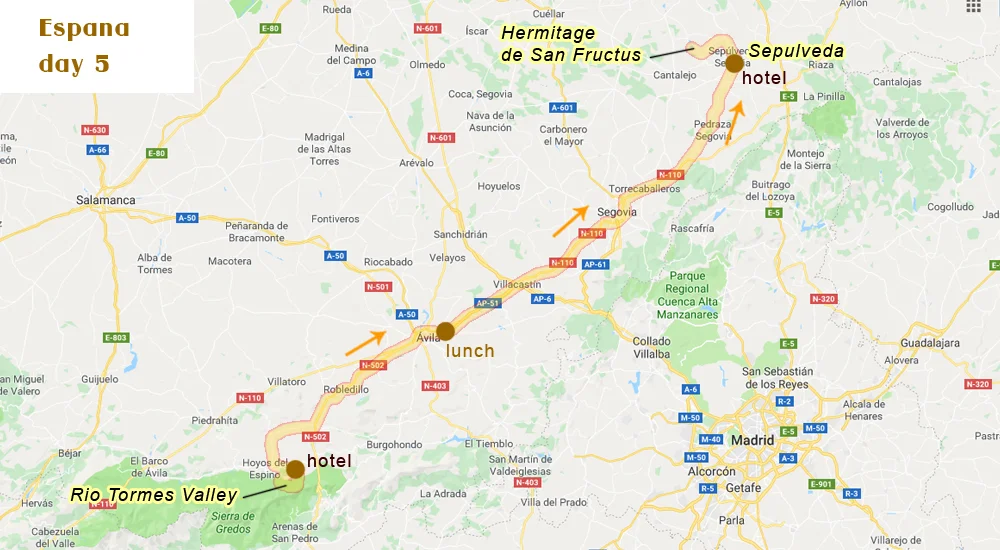
Not wanting to waste our last full day in Spain we woke early before it was properly light and we were serenaded in our beds by a calling Scops Owl. We were to drive north-east today but thought we’d do some early morning birding locally first. A suitable target was to try to get better views of Iberian Green Woodpecker, rather than our brief fly over. On the way to the mountains yesterday we’d passed through a valley which looked ideal - large areas of woodland interspersed with short grassy fields - the kind of place you’d get Green Woodpecker in the UK anyway. This was the valley of the Rio Tormes.

We stopped by the side of the road near a campground and wandered around listening. The woods in the valley were mainly pines and we had a nice selection of woodland birds. A few Great Spotted Woodpeckers were present along with both Nuthatches and Short-toed Treecreepers. There were Goldcrest, Coal and Crested Tits calling from the trees and we had one or two Crossbills calling overhead. Eventually we could hear the laughing call of an Iberian Green Woodpecker but it was a little distant and so we got in the car and drove towards the sound.

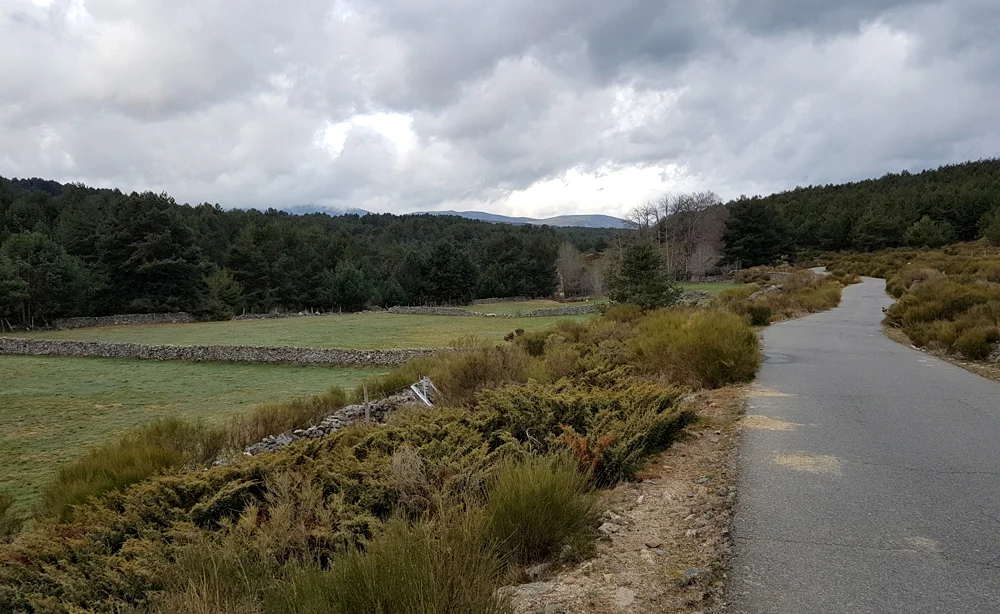
Rio Tormes Valley, 15 Apr 19

Rio Tormes Valley, 15 Apr 19

We found a minor road which followed the river valley bottom and drove along there, looking for open areas to stop and search. The first time we stopped we again heard distant woodpeckers and we also had a small flock of Crossbills land in a pine across the field and a Woodlark was singing. A bit further down, the road did a little twist as it climbed a small ridge, and just as we rounded a blind corner we saw two decent-sized birds fly up from the roadside and away from us showing a yellowish rump. They were indeed Iberian Green Woodpeckers and, luckily, instead of carrying on over the rise one decided to pause briefly on a small trunk and let me get my bins on it just for a second (it was the left hand trunk in the photo below). Very pleased with a perched view, we got out and tried to see it again but the area was fenced off. Surprisingly we had a Rock Bunting on the boulders here and we had a loud Bonelli’s Warbler singing from the trees on the other side of the road which I managed to record on my phone. The woodpeckers were nowhere to be seen and we moved on.

Rio Tormes Valley, 15 Apr 19

Rio Tormes Valley, 15 Apr 19

A little further on we found another wide open area which looked good for a scan (below). Again we could hear the woodpeckers calling from somewhere, and we also had a few Jay flying around the trees. The calling woodpeckers didn’t seem very close but I could hear the general direction they were coming from. I looked through a gap in the closer pines and saw a few dead trees at the far side of the next field. I thought to myself “that’s the exact spot where I’d expect to see a woodpecker” and sure enough, through the bins I could see a little greenish dot clinging to the trunk - a static Iberian Green Woodpecker!. We grabbed the scope out of the car and got decent ‘scope views of the bird as it sat there. It’s not obvious on the (poor camera-through-scope) photo below but the bird had less black in the face than a normal Green Woodpecker which gave the bird a more gentle, less angry-bird expression. We reckon we had about 6 different Iberian Green Woodpeckers along this short stretch, so a pretty good site for them.

Rio Tormes Valley, 15 Apr 19

Rio Tormes Valley, 15 Apr 19

Iberian Green Woodpecker - Rio Tormes Valley, 15 Apr 19

Iberian Green Woodpecker - Rio Tormes Valley, 15 Apr 19

The bird was on these distant dead trees - Rio Tormes Valley, 15 Apr 19

The bird was on these distant dead trees - Rio Tormes Valley, 15 Apr 19

It was getting close to our allocated breakfast time and so we thought we should head back towards the hotel. We turned north from the valley road and as we drove past a few buildings (the entrance to a camping ground) we stopped to look at something. As we stopped we could hear something calling which was unfamiliar, a bit Siskin-like but a little squeaky. We couldn’t quite see where it was coming from until we noticed the bird on the roof of the building - it was another Rock Sparrow. We might have realised what it was sooner if we were in a more expected, dry, rocky area, but this bird was singing on the edge of a pine wood. Although we failed to get very close to it, I was pleased at last to see one perched and visible. After dipping on the previous two trips, I had now seen Rock Sparrow three times and, for each one, just bumped into it. We saw that there were two birds present before they flew off - perhaps they were breeding here.

Rock Sparrow - Rio Tormes Valley, 15 Apr 19

Rock Sparrow - Rio Tormes Valley, 15 Apr 19

The breakfast at the hotel was pretty meagre - basically coffee, bread and jam - but we ate up and set off north with 2 to 3 hours of driving ahead of us. It was a really dull day compared to recently with lots of cloud and spots of rain. It was a pleasant drive through the rolling hills and upland valleys until we spilled out onto flatter more agricultural areas. Near the village of Solosancho we saw our only Great White Egret of the trip and we reached the town of Avila. Here we decided that we should visit a supermarket where I stocked up on cheese and bread for some much-needed sandwiches plus some crisps and biscuits - we would not go hungry today!

After our stop we continued north-east, skirting the old city of Segovia and with the next sierra to our right. Our route crossed through some lovely green arable land and we saw Calandra Larks here and two different male Montagu’s Harriers. The further we went away from the foothills, the drier the terrain got and we soon snaked down the edge of a gorge into the rather spectacular town of Sepulveda. This is a well visited town by birders, because it is the closest area to Madrid where the enigmatic Dupont’s Lark can be found, and of course, this was the reason we were here. The town itself clings onto the rocks which span between two deep gorges, the kind of place which was founded when defending from pillaging hordes was a priority. We checked into the hotel and had a little rest before heading out again.

It is well known that Dupont’s Lark is a bird of the early morning and so we didn’t really plan to go searching for it until the next day. However, we thought it might be a good idea to check out the stake out, which is along a road about 10km NW of Sepulveda. Andy had been here before and had Dupont’s on his list but he hadn’t seen one very well (as nobody hardly does) so was keen for another shot. By now the sun was out but the wind had picked up and would be classed as pretty strong and annoying. Approaching the site, the road dropped into a little gulley and we decided that we’d make the most of it and see what was here, out of the wind.

We found it was a nice little spot and we had plenty of birds here. The best looking was no doubt the male Black-eared Wheatear which flew across and perched up on the rocks. I was really pleased to see this - I thought we’d have had one before now. This was the first BEW I had seen for many years and even then I’d only ever seen the eastern race before, so this was a new subspecies - always useful in these days of heavy splitting! We also had a singing lark on the same rocks and only after a while we realised that it looked a bit different than the Crested Larks that we’d been seeing, and was no doubt a Thekla Lark. The id of this species is notoriously hard but this bird was a lot more “in focus” than the Crested Larks, which always seemed to have their features a bit fuzzy and blurred. You could see every sharp streak on the Thekla, especially on its breast. We also saw a showy Woodchat Shrike and a peculiar Field Cricket crossing the track (not sure of the species - I think they have a few types here).

Black-eared Wheatear - Sepulveda, 15 Apr 19

Black-eared Wheatear - Sepulveda, 15 Apr 19

Thekla Lark - Sepulveda, 15 Apr 19

Thekla Lark - Sepulveda, 15 Apr 19

Woodchat Shrike - Sepulveda, 15 Apr 19

Woodchat Shrike - Sepulveda, 15 Apr 19

Field Cricket sp. - Sepulveda, 15 Apr 19

Field Cricket sp. - Sepulveda, 15 Apr 19

Driving back on top of the plateau the wind seemed to be still gusting strongly, making birding pretty unlikely. We decided that we’d head to the end car park where you could go look at the Hermitage of San Fructus - the patron saint of all things sugary. We were very impressed by this tourist site, perched on a narrow promontory above the flooded gorge below, steep cliffs 300 degrees all round. We spent a relaxing time here looking round the site. There were a few birds to see including a mixed flock of Jackdaw and c.30 Chough swirling round the cliff tops on the opposite sides. As well as the mighty Griffons which were quite common we had a single Egyptian Vulture go over. In one of the bushes along the promontory we were surprised to find a male Subalpine Warbler battling against the wind to sing its song. On the walls of the Hermitage itself we saw a nicely marked wall lizard sp sunning itself and clumps of an unusual flower we later learned was called Sarcocapnos enneaphylla or “Zapatitos de la Virgen” (Virgin’s Slippers). We only saw it here and in Sepulveda town centre.

Hermitage de San Fructus, Sepulveda, 15 Apr 19

Hermitage de San Fructus, Sepulveda, 15 Apr 19

“Tombs of the Saints” - Hermitage de San Fructus, Sepulveda, 15 Apr 19

“Tombs of the Saints” - Hermitage de San Fructus, Sepulveda, 15 Apr 19

Hermitage de San Fructus, Sepulveda, 15 Apr 19

Hermitage de San Fructus, Sepulveda, 15 Apr 19

Hermitage de San Fructus, Sepulveda, 15 Apr 19

Hermitage de San Fructus, Sepulveda, 15 Apr 19

Hermitage de San Fructus, Sepulveda, 15 Apr 19

Hermitage de San Fructus, Sepulveda, 15 Apr 19

Wall lizard sp. - Hermitage de San Fructus, Sepulveda, 15 Apr 19

Wall lizard sp. - Hermitage de San Fructus, Sepulveda, 15 Apr 19

Sarcocapnos enneaphylla - Hermitage de San Fructus, Sepulveda, 15 Apr 19

Sarcocapnos enneaphylla - Hermitage de San Fructus, Sepulveda, 15 Apr 19

Sarcocapnos enneaphylla - Hermitage de San Fructus, Sepulveda, 15 Apr 19

Sarcocapnos enneaphylla - Hermitage de San Fructus, Sepulveda, 15 Apr 19

We returned to the car and it was now quite late in the afternoon. The wind was still whipping across the gorge and we didn’t really have any further plans or anywhere else to go. Not wanting to waste the little time we had left we thought we’d just keep stopping along the “Dupont’s Track” and see what we could see. The first thing was another excellent male Black-eared Wheatear at very close quarters this time that we were able to watch from the car - what a cracker of a specimen!

Black-eared Wheatear - Sepulveda, 15 Apr 19

Black-eared Wheatear - Sepulveda, 15 Apr 19

For the next hour or so we took it in turns to sit in the car whilst the other person went for a wander through the rocky terrain. Just looking at the habitat here you could see how a Dupont’s could spend all of its time hidden away - lots of rocks and lots of tussocks to hide behind. Nevertheless, I still had enough enthusiasm to search and did see plenty of larks including a nice Woodlark and a Short-toed. There were also both Crested and Thekla here, or so it appeared and I think I managed a photo of both together. I got startled about five times by flushing hares from right in front of me. Reading up on these, it seems that these hares are a different species to British ones, being Iberian or Granada Hare (Lepus granatensis). The variety of species in these rocky fields here wasn’t huge but we did get a couple of Tawny Pipits and a Cirl Bunting as it was starting to get dark. But despite my laughably unrealistic hopes, no surprise Dupont’s.

Dupont’s Lark habitat - Sepulveda, 15 Apr 19

Dupont’s Lark habitat - Sepulveda, 15 Apr 19

Crested Lark (left) & Thekla Lark (right) - Sepulveda, 15 Apr 19

Crested Lark (left) & Thekla Lark (right) - Sepulveda, 15 Apr 19

Tawny Pipit - Sepulveda, 15 Apr 19

Tawny Pipit - Sepulveda, 15 Apr 19

Back at the hotel, it was now dark and the photo by the reception desk of a laughing Dupont’s Lark mocked our foolish attempts at looking in the day time. Of course, we didn’t really think we’d see one, tomorrow at first light was our plan to tick it off. We freshened up in the room and watched Notre Dame burn on the television before heading out into the town for something to eat. We found a backstreet restaurant which, quite surprisingly from its outward appearance, was bedecked in neon strip lights and plastic palm trees. The food was a let down from the previous evening and I was back to Spanish omelette yet again. After a beer or two we wandered back to our lodgings ready to get up before first light for a proper try for the elusive denizen of the Spanish steppes, the Dupont’s Lark.

Hotel reception, Sepulveda, 15 Apr 19

Hotel reception, Sepulveda, 15 Apr 19

Sepulveda town at night, 15 Apr 19

Sepulveda town at night, 15 Apr 19

espana map day 5.jpg