Tuesday 28th February 2017
/February is generally a pretty quiet month, with birders - and birds - mainly waiting in a holding pattern until spring starts to appear. However February 2017 was a superbly exciting month and it will live long in the memory.
I touched down at the Airport on Sunday 5th February around midday, after my weekend away in Norfolk and drove home. I said hello to everyone and, before the kettle had even boiled for my cup of tea, I received a text message from the grapevine: "Miellette - 1 Royal Tern - unidentified orange-billed tern in bay 1250 (JH)". Bloney Hell!! What a shock. I said to the family that I was sorry I'd only just returned, but I simply HAD to go. I literally had no choice. Rosie informed me that she was going to be going out at 2, so I had just a short window to see what this bird was - a Royal Tern as Jamie suspected, or maybe it was something else! Whatever it was, it was ridiculously unexpected in the middle of winter.
I jumped back in the car and hurried there straight away, and living fairly close to the north of the island I was one of the first to arrive. Jamie was waiting by the car park and told me that it had disappeared around the headland to the north a short while ago and hadn't come back. Grrrr!! I told him that I would drive round to Fort Doyle and watch from there, and we'd phone if either of us saw it. After ten minutes of sheltering from the pretty stiff north-westerly winds, I still hadn't seen it. Then Jamie phoned - it was back! I sprinted back to the car and threw it recklessly round the narrow lanes between the two sites - Jamie said he heard me honking the horn all the way there. I screeched through the gravel in the car park at Miellette, dived out of the door and - thank god - it was there, right above the beach, and above me, hovering in the wind. I punched the air.
Although I was not an expert on large terns, I could not see it as anything other than a young Royal Tern. It had a reddish-orange bill, not chunky enough for Caspian, not long enough for Elegant and not pale enough for Lesser Crested. Although this seems a simplistic ID process it is pretty reliable for most birds. I took my bins off the bird to steady myself and catch a breath and it caught the wind and skipped away at speed. I congratulated Jamie, and other birders started to arrive, but the bird had not come back yet.
Vagrant Royal Terns have been notoriously short-staying and elusive in Britain and so my main feeling was huge relief that I'd managed to see it at all - albeit very briefly. I had horrible thoughts about it turning up the previous day instead, when I was stuck in the UK. This alternative scenario was making me feel physically sick - the massive wave of relief washing over my body drained me of all my energy, and I felt a very fortunate fellow.
As I was needing to rush back home, I told everyone that I would check a few places on the way, but I saw nothing. And it was a good job I did have that brief sighting as I understand it took a few hours before the bird returned to the bay and most of the keen birders eventually ticked it off. What a red-letter day for Guernsey birding!
Of course, I was not satisfied with such a brief sighting of the Royal Tern and so, at work the next day I had fingers crossed that it would be seen again and be gettable. At lunchtime I checked the phone and saw that there had been a sighting at Rousse a short while previously. So I jumped in the car and drove there quickly. Unfortunately, I could not find it, and subsequently learnt that I had literally driven right past it as it sat on rocks in Baie des Pecqueries - the epicentre of my local patch! Not a happy bunny.
The next opportunity was two days later on Wednesday 8th February with another grapevine message picked up at lunchtime of it being seen from Salerie in Town a few minutes ago. It's a bit unpredictable heading into town in lunch hour with the traffic, but on Wednesdays I am free after lunch so it would not be an emergency if I got stuck. But I got there really quickly and parked up, with the few people there saying they couldn't see it. And then, just like that, it majestically flew in from the right, circled a couple of times and landed on the rocks below. Yes!
Of course, as it was static, I was able to get the 'scope out and had terrific views from the top of the sea wall. It was not close enough for any more than record shots with the camera but I managed some film of it with the phone through the scope. One thing that I noticed straight away was that it was ringed on the right leg - nobody had mentioned this the other day. So after good views of the bird at last I headed back to work.
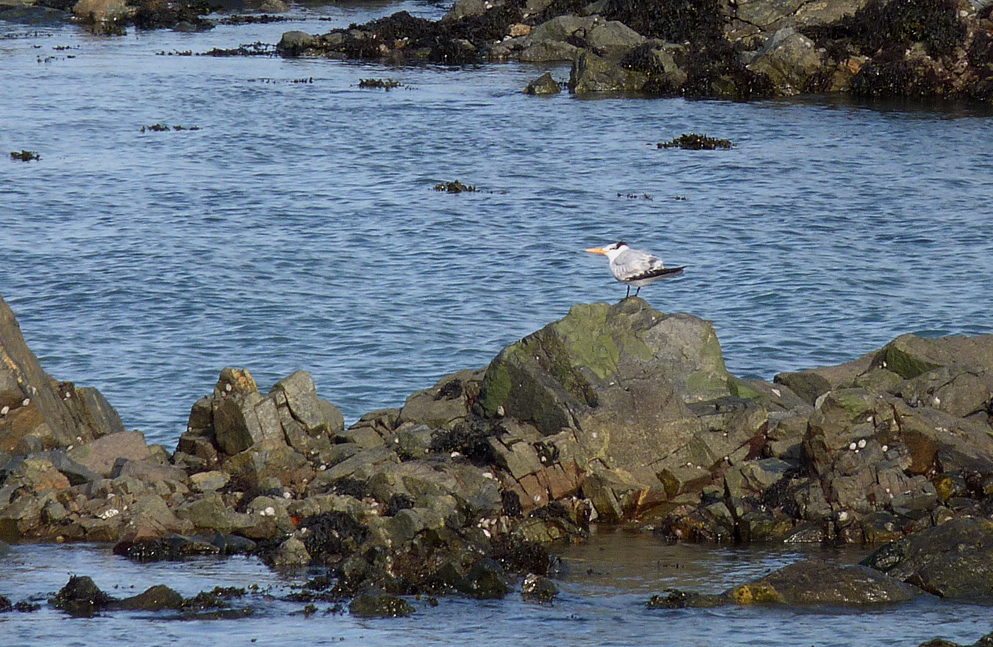
Royal Tern - Salerie, 8 Feb 17
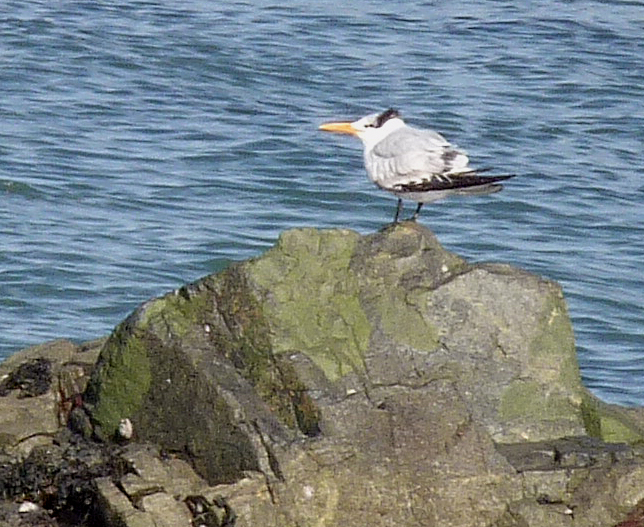
With interest in this bird from around the UK, it soon became clear that there might be a problem with this bird regarding its place on the island bird list, and of course our personal lists. There was talk that a study into the genetics of Royal Tern has shown that the American race and the African race were in fact very different from each other and were probably two different species. The problem being that these two populations were practically identical to each other in the field! Oh dear. Which one did we have?
So, the call was put out to the island's birders: either a) we can get close enough to read or at least photograph that metal ring, or b) we can get some kind of sample of the bird for DNA testing - a feather or even a poo! Up to now no one had seen it even slightly close enough to read the ring, so our best bet was probably a faecal sample. The bird was seen a couple of times before the end of the week but still not well enough.
A few days later on Saturday 11th February, in very cold and sleety conditions, Andy M found the bird again off Salerie and I went down there with the intention of watching it do a poo. Just as I arrived, Andy was climbing down the slipway shouting back to me that he'd just seen it poo! Excellent stuff. So I skidded down to join him and we went to try and find the plop on the slippery rocks. He had taken a photo of where the bird had done its business and so we tried to track the spot down. As we did so the Royal Tern appeared again from behind the rocks and flew north out into the bay. After some difficulty with angles and changes in tidal conditions, and wet feet, we eventually found the spot and found the splash of white poop.

Royal Tern poop!
The rocks were very wet and most of the liquid matter was impossible to get off the rock. I had planned ahead and brought a penknife and moth pot with me and, mainly due to Andy's sharper eyes, we managed to get a smallish sample of more solid matter. Whether it will be enough, only time will tell.

Andy's before and after shots that we used to locate the spot show that the poo in question had to be the Royal Tern's. You can see the pale vertical stripe of rock just to the left of the splatter (with the two limpets on it) in the above close-up photo too.

Not a lot of Royl Tern poop - will it contain enough DNA?
The next day, on Sunday 12th February, Mark G. found the Royal Tern again, this time in Grandes Havres perched on the sand in amongst the Black-headed Gulls. This time I raced up there specifically to try and get it on my Patchwork Challenge patch list. Grandes Havres beach is not strictly inside the patch zone, but definitely viewable from it. I jumped out of the car at the Vale Pond car park to locate where it was standing, then jumped straight back in the car and drove round to Rousse kiosk, put up the scope and saw a distant but distinct white blob standing in just the right spot. The tern was unsatisfactorily, but technically, on the patch list!
I drove back again and 'scoped up the bird as it sat on the beach, before it was quickly spooked by typically selfish people walking right across the bay, and it flew off towards L'Ancresse. It had been again been too far away for me to take anything more than record photos, but below you can see a proper photo of the bird from Mark G who managed to get much closer to it when he first relocated it on the beach.
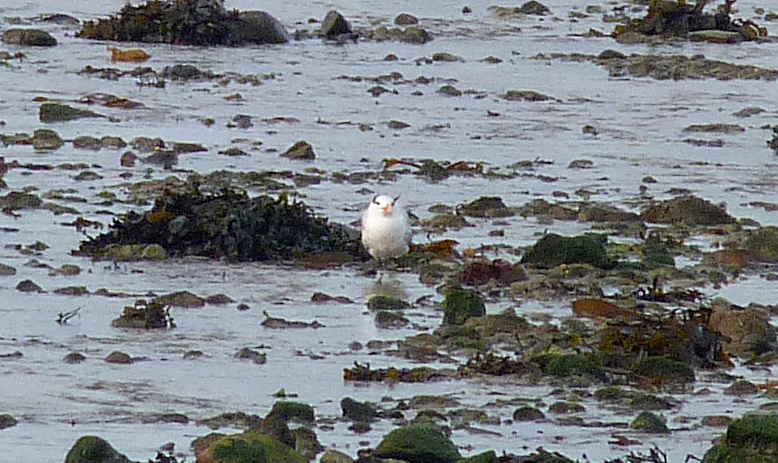
Royal Tern - Grandes Havres, 12 Feb 17

Royal Tern - Grandes Havres, (Mark Guppy)
In the next few days we managed to make a little bit of progress with the ring, aided by the closest photos yet of the bird by Chris B as it was roosting at high tide in Grandes Havres. I was initially very dubious about how much info we could get from the photos as the only clear digits were a 6 and a 0. However, once I found decent pictures of American rings used on the Royal Terns there, the exact patterns of where the text are and where the digits are compared to each other, match up really well (as can be seen on the pic below). I am convinced that this ring has to be an American ring on this evidence.

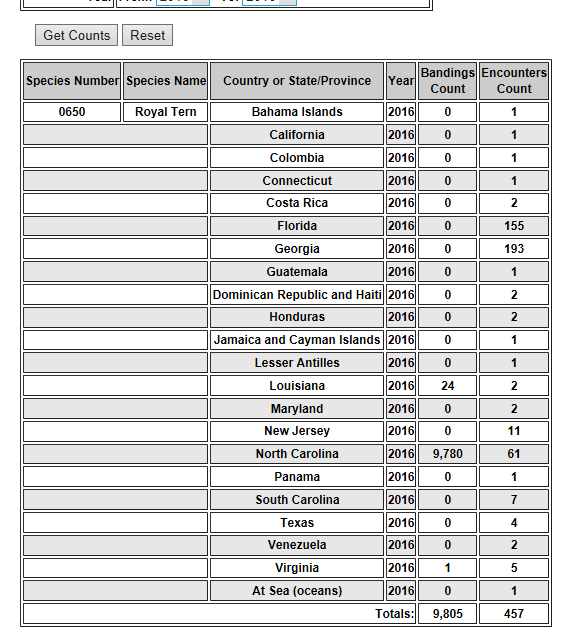
Looking at the stats on the American bird banding website (below) you can see that 9805 Royal Terns were ringed in America last year, almost all in colonies in North Carolina. We know that the bird had to be ringed in 2016 as it is a first-winter bird, less than a year old, due to the amount of black in the plumage. To go with this evidence, no-one can find anyone that was ringing African Royal Terns in 2016. So it seems that all the evidence points to this bird being an American Royal Tern.
We all thought that the Royal Tern had gone as there had been no sightings for over a week, when it was refound again on 24th Feb. It may have spent some time on another island I suppose. Two days later on Sunday 26th February it was sighted again in Vazon Bay and I hurried down to see it again. My aim this time was to get close enough to it with the scope to try and get a full ring read. Despite putting my wellies on and clambering out into the sea and getting reasonably close to it, it always remained stubbornly on the wrong side of the rocks and I failed in my mission. I was pleased to get pretty good views again though and this time I saw the bird fly away and actually fly through my patch as it made its way north.
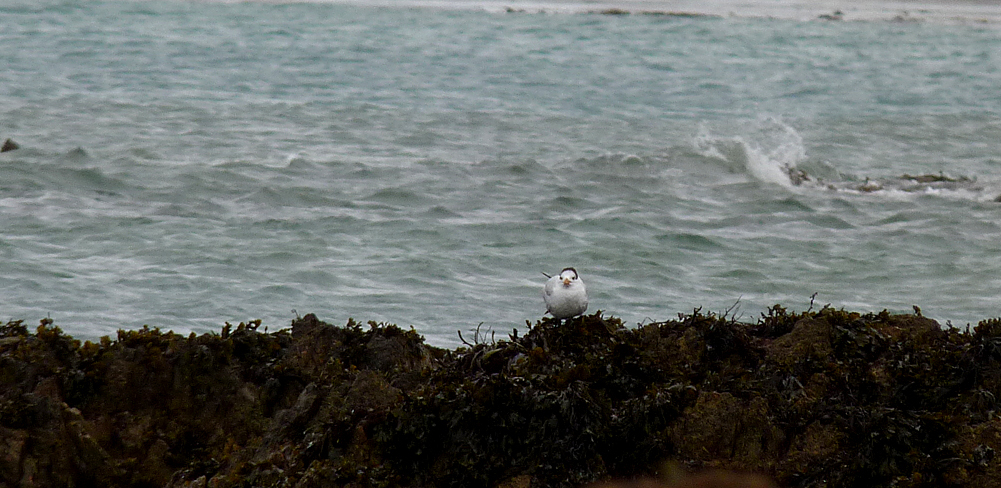
Royal Tern - Vazon, 26 Feb 17

Zooming out from the above photo shows my 'patch' in the background

My only previous Royal Tern encounter was as a 18-yr old cool dude on a family holiday in florida in September 1990.
With such a mega on the island during the month, any other sightings were merely an optional side dish. There was a Red-breasted Merganser in Pecqueries on 7th, and a Common Scoter in Belle Greve Bay on 11th. A Cattle Egret took up residence around the Vale Pond and I saw it in the adjacent cow field late in the evening on 15th and on the pond itself the next day.

Cattle Egret - Vale Pond, 16 Feb 17