Saturday 13th April 2019 (b)
/BUBO in ESPAÑA - part 5
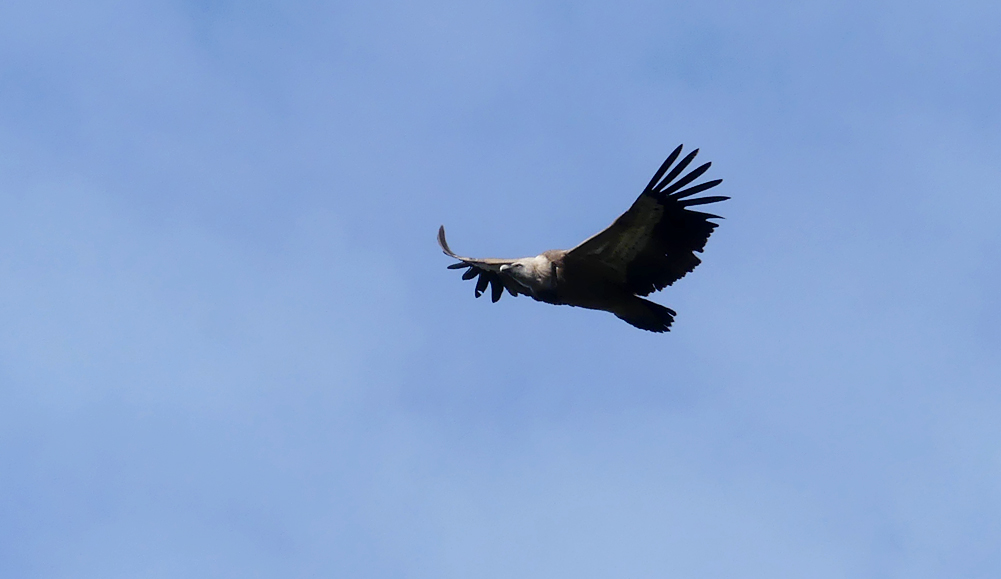
After lunch we snaked around the contours of the north slope of the Tagus river valley, heading east across Montfrague. When the road dropped down, almost to water level, there was a pull-in at the Mirador La Tajadilla and we stopped for a quick scan. The cliffs opposite were too distant and there were too many people around so we didn’t stay long. However, as we were getting back into the car we saw a Black Vulture come up over the hill behind us. It was soon followed by a second bird and, rather than flying away like all the others had done so far, these bird actually glided across the sky towards us. I finally managed a close look at the species and some very pleasing photos were taken.

Black Vulture - Mirador La Tajadilla, 13 Apr 19

Black Vulture - Mirador La Tajadilla, 13 Apr 19

Black Vulture - Mirador La Tajadilla, 13 Apr 19
The road crossed a dam, one of many in this part of Spain which turn these valleys into long, slender reservoirs, and then wound upwards to the Mirador La Buscela high over the valley, an excellent raptor-watching spot. We had three species of vulture from this spot - the obligatory Griffons, two Black Vultures (possibly the same as we saw just previously) and a single Egyptian. I was getting quite warm and sweaty although it wasn’t especially hot for Spain in the spring, but it was very bright and it was difficult to see birds against the sky. A male Subalpine Warbler showed really well singing atop a dead tree just next to the watchpoint where a Clouded Yellow flicked about. I had a little wander, mainly looking for more butterflies and came across a lizard in the leaf litter which I managed to photograph and later identify as a Large Psammodromus Lizard, one of the most common species here.

Raptor-watching at Mirador La Bascula, 13 Apr 19

Large Psammodromus Lizard - Mirador La Bascula, 13 Apr 19
We then went north, crossing the next ridge and back down to the waterside, stopping at the same spot as the very first evening, Portilla de Tietar. It felt ages ago that we had come here, but was actually less than 48 hours before. You try and fit so much in when you are birding away from home that the time stretches and stretches and the four or five day trip can feel twice as lengthy. We saw pretty much the same range of species here as we saw on Thursday, including Blue Rock Thrushes and Black Redstarts way across the ravine, Crag Martins and Red-rumped Swallows racing back and forth, and even two Spanish Imperial Eagles soaring. They were initially showing much lower than before and I managed better pics, but both birds soon gained height. The Griffon Vulture colony had active nests and we even saw a couple of very young birds there with the adults.

Portilla del Tietar, 13 Apr 19

Spanish Imperial Eagle - Tietar, 13 Apr 19

Griffon Vulture - Tietar, 13 Apr 19
Whilst there, we got chatting with two Spanish birders from the Madrid area and they told us of a couple of other interesting species’ nests that were visible from the roadside a short way further south down the ravine. Following their directions we pulled up and scanned across the water. The first nest we found was a Black Stork nest on top of a dropping-spilled rock, quite low down near the water. Then from the same spot, just a little further south we found the Egyptian Vulture sat on its nest in the shade, probably even closer to the water than the stork.

Black Stork on nest - nr Tietar, 13 Apr 19

Egyptian Vulture on nest - nr Tietar, 13 Apr 19
It was now well into the afternoon and our plan was to head east out of Montfrague Park and visit the larger Reservoir of Embalse de Arrocampo. We had a few reasons to visit here - it’s always nice to visit a wetland site when on a trip to get to see a larger selection of species, also the area is well known for being good for Black-winged Kite, and - *whispers* - it is a known site for the naturalised - *coughs* - Red Avadavat. The drive across took us from the rolling hills and crags of Montfrague into a flatter, open landscape where crops were growing in many of the fields. We drove through the town of Saucedilla and found the visitor centre. The boys went inside to get some gen whilst I waited by the drainage ditch watching Swifts and Bee-eaters overhead and a White Stork tidying its nest on top of a small pylon.

The first hide at Embalse de Arrocampo nature reserve, 13 Apr 19

White Stork - Embalse de Arrocampo, 13 Apr 19
We went into the first hide using the key collected at the visitors’ centre and we scanned across the marsh at the north-east corner of the lake. It didn’t really get us much closer to the water, but the extra height meant we could see a lot more. The selection of common waterbirds was typically sparse for these southern European wetlands - mainly Coots, Cormorants, Little Grebes, Stilts - but we picked up a few extras. One or two Purple Herons were seen flying across the tops of the reeds, and a Spoonbill did likewise. Marsh Harriers surveyed the beds regularly, joined by both Black and Red Kites on occasion. Cupping our ears we picked out a couple of Savi’s Warblers reeling above the raucous Reed Warblers. This site is apparently one of the best in central Spain for the patchy-distributed and local Savi’s Warbler. Way in the distance we thought we saw a small gull flying up and down but it revealed itself to be a Gull-billed Tern. One of the highlights of the whole trip was not actually seeing a gull all week!
After a while we decided to go for a walk around the edge of the lake and the sun was getting quite blazing. My neck and face definitely felt a little taut next morning. Fan-tailed Warblers were common along the pathside and we were on the lookout for small finch-like birds with red beaks. As the path got close to the next bit of water we found a Spanish Terrapin in a tussock of rush that we could have picked up if we’d wanted, and we also noticed a few dragonflies in action. We didn’t recognise them and I presumed that they were probably the same species as the Western Clubtail we saw the previous evening. I managed some decent photos and, analysing them at home afterwards, saw that the species involved was Long Skimmer. This is an African species that has only recently colonised Iberia and is clearly moving north quickly. This location was well north of the distribution as shown on the map in the field guide. The other species here was the intense Scarlet Darter, which was a little more shy of the camera.

Long Skimmer - Embalse de Arrocampo, 13 Apr 19

Scarlet Darter - Embalse de Arrocampo, 13 Apr 19
As we got close to the second hide, there was a little bit of open water to the right which had a smart Ferruginous Duck swimming around amongst the Coots. We thought we had some small finch-like birds in the vicinity but we lost them before we could have a chance at identification. Looking around this area, we also had a single Purple Gallinule/Swamphen crash down into the reeds and also a Little Bittern popped out and gave a wee fly-past over the reed tops - two quality species. At the edge of a field, a migrant Wheatear was flushed and I was startled by a huge 4 inch grasshopper, which turned out to be Egyptian Grasshopper.

Egyptian Grasshopper - Embalse de Arrocampo, 13 Apr 19
We decided that the third hide was far too far to walk in our tired states and we headed back towards the car. I had a second Purple Gallinule fly over and plunge into the reeds like a plummeting biplane and then I picked up three small, finch-like birds fly in and land on the track way in front of me. Through the bins I managed to see a red beak and I shouted back to the boys that I’d found the Avadavats! This would be a new species for me and a Western Pal tick for Andy (Ian and Daniel had seen some a few days ago somewhere else). However, the birds took flight almost immediately and seemed to go in three different directions. Luckily one landed on the fence level with me and I quickly took a couple of snaps before it seemed to vanish into thin air. The others had now caught up with me and we stomped around, failing to refind them. It was only then that I looked at my photos on the camera and realised that I’d been reckless with the ID. I had presumed that a tiny red-billed exotic finch here would certainly be the “advertised” Avadavat. However, I had totally forgotten the other tiny red-billed exotic finch that is also at large in these parts, a species I had seen in similar circumstances only last year - the Common Waxbill - and this bird was certainly one of them, and NOT an Avadavat!

Common Waxbill - Embalse de Arrocampo, 13 Apr 19
As we were getting back into the car, Andy saw another Little Bittern drop into the tiny clump of vegetation in the concrete drainage channel right next to the road. Despite us looking from all angles it refused to be seen - what an elusive beggar! We set off north, back through the village of Saucedilla following the directions of the visitor centre woman, who had told the lads some good areas to look for Black-winged Kite. At a crossroads halfway to the next town we took a minor road west and looped back around towards the reservoir. There were lots of scanning spots here and we did indeed scan rather a lot, checking every piece of sky and the infinite perching posts, but we found no tiny kites. We picked out plenty of hovering raptors but they all turned out to be Kestrels. At one location we were entertained by a small flock of Bee-eater chasing insects. We found a nice pond with a migrant Redshank feeding with the ubiquitous Stilts. This pond, along with most ponds and streams here, was densely packed with Water-crowfoots as can be seen on the stilt photo below.

Bee-eater - nr Saucedilla, 13 Apr 19

Black-winged Stilt amongst Water-crowfoot - nr Saucedilla, 13 Apr 19
We retraced our steps and tried a road to the east of the crossroads. This side was a little less flat and over the first rise we came across a really beautiful rolling, grassy meadow where we soon saw an even more beautiful Black-winged Kite. We dived out of the car and we could ‘scope it up as it perched on the top of a dead tree at the far side of the field. Totally unmistakable with its ghostly pale plumage and unusual shape. Something we wee not aware of beforehand was the strange tail-pumping behaviour of the bird. It would slowly lift its tail high and vertical above its back before dropping it down again just as slowly, and it did this almost constantly whilst perched.

Fields north-east of Saucedilla, 13 Apr 19

Black-winged Kite - Saucedilla, 13 Apr 19

Black-winged Kite - Saucedilla, 13 Apr 19

Black-winged Kite tail pumping - Saucedilla, 13 Apr 19
The bird took flight after a while and started soaring around where the distinctive shape and plumage were again obvious. What an enigmatic species, unlike any other. After it perched again on a more distant treetop, a second bird suddenly appeared next to it flying in with legs dangling. Perhaps this was an explanation of the tail-pumping, maybe some kind of display. Although I was happy to have ticked the species two days ago on a speedy drive-by, it was great to be able to watch a (presumably) breeding pair amble around their picturesque natural habitat, with a stunning backdrop of snow-capped mountains. What a treat.

Black-winged Kite - Saucedilla, 13 Apr 19

Black-winged Kites - Saucedilla, 13 Apr 19

Black-winged Kites - Saucedilla, 13 Apr 19
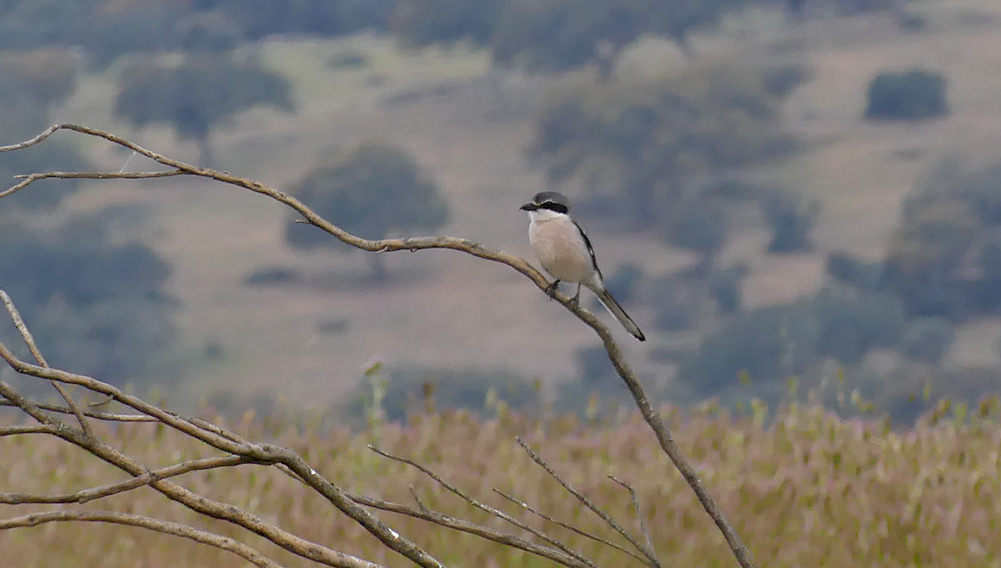
We couldn't think of a better way to end the day and we started to head back, driving past another Iberian Grey Shrike at the back of the kites’ field. We stopped off for some dinner at a restaurant alongside the main road back to Trujillo, where I ordered - you’ve guessed it - Spanish omelette again. I was relieved that, this evening, I was free of any headaches and was able to relax and enjoy a couple of beers in the hotel. Saturday night was clearly locals night, and we were entertained by a bevy of slightly merry local farmers spending their jamon money and enjoying “El Banter”, one of which decided to do a little jig in his overalls in the middle of the bar. You’re not gonna get that kind of ‘authentic’ entertainment on the Costa del Sol!

Our route for the day

Locations in Montfrague Park