Thursday 16th May 2019

5TH MAY - GUERNSEY BIRD RACE 2019

The first Sunday of the month and it was the annual Guernsey Bird Race. Meeting up at the usual time of 5 am, the Sultans of String were not especially expecting a large total for the day. This year there did not seem to be a number of “lingering” birds to tick off, with few scarcities hanging around and the forecast clear skies and light northerlies were not going to be too helpful. However, we knew that the race is often unpredictable and that not all migrants had come through yet.

We immediately made our way up to Pleinmont for some first light flyovers and we immediately saw that there had been a small arrival of warblers during the night. Just next to the car park we had a Sedge Warbler and a Lesser Whitethroat singing from the scrub and we soon had both Willow Warbler and Yellow Wagtail under the belt. We made our way towards where the Cirl Buntings had been hanging around. These birds arrived here whilst I was in Spain and I had not caught up with them yet. As we walked past the gate, an early morning Swift flew over and we found both the male and female Cirl Buntings feeding in the weeds alongside the fence. These birds seemed pretty settled and we hope they may stay and breed for the first time ever in Guernsey.

Male Cirl Bunting - Pleinmont, 5 May 19

Male Cirl Bunting - Pleinmont, 5 May 19

Female Cirl Bunting - Pleinmont, 5 May 19

Female Cirl Bunting - Pleinmont, 5 May 19

As we rounded the corner by the Swallow Bunker, a Lapwing flushed out of the field and flew off inland which was a bonus bird as there hadn’t been any of these around. A Reed Warbler and a Whinchat had joined the migrants around the Societe fields and a handy Peregrine shot past. We left the headland on a pretty good 42 species but it was already about 0730. We probably should have been a little more speedy up there as time was starting to push on.

Driving past Rocquaine and L’Eree we picked up a few decent waders - Whimbrel, Dunlin, Bar-tailed Godwit - and also what was probably the same Lapwing on the aerodrome. Another bonus species was the Black-headed Gull off the shingle bank which is easily missed on the day. Calling in at the Claire Mare we ticked off singing Cetti’s Warbler and also a sleeping Spoonbill. It was tucked so far in to the left of the hide that it wasn’t seen by one of the other teams that were in the hide at the same time. We had to communicate by hand signals and eye movements to make sure we all had seen the bird without letting on to the others! A Wheatear at Fort le Crocq and both Common Sandpiper and Goldcrest at the Reservoir brought us up to 59 by 9 am.

The Sultans searching at the Reservoir for species - 5 May 19

The Sultans searching at the Reservoir for species - 5 May 19

Soon after at Grande Mare we maybe saw the rarest bird of the day slip through our hands. As we walked along the douit towards the golf course, we flushed a bird from the weeds alongside the ditch. It was pretty brown with a reddish tail. Female Redstart is the most obvious option here but something about it made us think of Nightingale. It flew into the trees on the right hand side of the track and was very elusive and we had brief views deep in the bush before it slipped away. I am sure if it had been a Redstart it would have been less skulking and I think it was very likely a Nightingale from what I saw. Whatever it was, it was not identified and didn’t count for the day list!

Back at the coast we lopped off a few more waders with Turnstone at Vazon and Sanderling and Ringed Plover at Grandes Rocques. The morning was now moving on and we didn’t get to Saumarez Park until 1025 which was far too late as the park was filled with parents and toddlers. We were lucky in picking up a drumming Great Spotted Woodpecker and we also had Short-toed Treecreeper and Firecrest, but didn’t have any bonus birds here which is often the case. We were now on 70 species at 11 o’clock. This was a pretty good total for the time of day but, apart from a few obvious species, it was difficult to see where the extras would be coming from. We tried the south coast again to see if we could add a couple more migrant species. There were plenty of Blackcaps and Chiffchaffs at Icart but nothing new. We then spent quite a while searching the Rue Tonelle area as both Spotted Fly and Turtle Dove had been present there during the week but we found neither. After two hours we had only added 4 more species which was not very efficient bird racing.

Trying to get back on track we hit a few more areas but it was not until 1330 that we had our next tick - a Marsh Harrier at the unusual spot of Pulias - bring us onto 75. Our next activity was jumping on the boat to Herm and ticking off Guillemot (76) on the way over. We were chuffed that the boat would be travelling round the back of Jethou and we thought that Puffin would be a breeze. However, constant frantic scanning revealed no sea parrots, just a few Razorbills (77). We then had to make the decision whether to spend a while on Herm to get Puffin or not and we decided not to. I think we were all a bit too tired to contemplate racing round Herm for an hour! This meant gambling that Puffin would suddenly reappear on the way back - it didn’t - but we did have a Raven (78) over the cliffs.
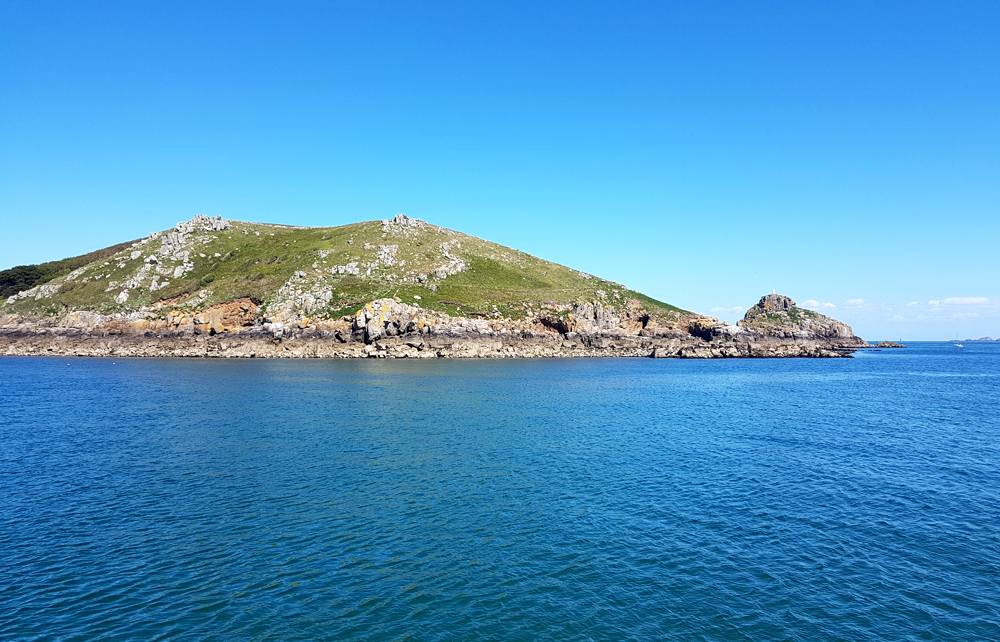
A Puffin-less Jethou - 5 May 19

A Puffin-less Jethou - 5 May 19

We still had a couple of definites to tick off and we headed to the Grand Pre which can often have a surprise. We thought we were going to strike out there too until we flushed a Tree Pipit (79) off the track and into a tree on the way out. Up to Fort Doyle next where we had 3 Common Terns (80) fishing offshore and the breeding Meadow Pipits (81) on the hillside.

Tree Pipit - Grand Pre, 5 May 19

Tree Pipit - Grand Pre, 5 May 19

A large gap in the list was Sparrowhawk and with the sunny weather we thought that Raptor Ridge would be a suitable spot to see one - and it was (82). We then headed down to the Jackdaw site on the south coast and saw one quite quickly (83). It was about ten to six now and we usually get a few species in the evening to boost our total, so we hoped for a late-80’s finish. However, wherever we went we seemed to miss out with nothing new in at Pleinmont or L’Eree despite our efforts. Eventually a distant Manx Shearwater (84) was ‘scoped off the Shingle Bank at 1920. We made our way northwards checking a few sites en route but we couldn’t eek out any more species. We tried a seawatch from Chouet and again it drew a blank. We waited for owls in the usual spot and we saw nothing.

So we finished on a disappointing 84 species which we felt was rather low for the day. We reckoned we should really have been knocking on the door of 90 as there was enough migrants around, and in the end we didn’t record the highest score this year. I think we were a little unlucky and we all were probably lacking a bit of energy on the day, which resulted in too much ‘birding’ and not as much ‘racing’. It just didn’t go as smoothly this year as it could have done, but we still had a great laugh as usual and it was a super day out in the field. The Sultans shall rise again!!

The Sultans of String - 20 years of bird races!

The Sultans of String - 20 years of bird races!

The birding during the next week or so was quite pleasant but there was nothing rare to see. The odd migrant trickled through the patch such as Yellow Wagtails and Common Sandpipers. On 16th May there was a nice selection at Fort Hommet with both Pied and Spotted Flycatcher in the pines.
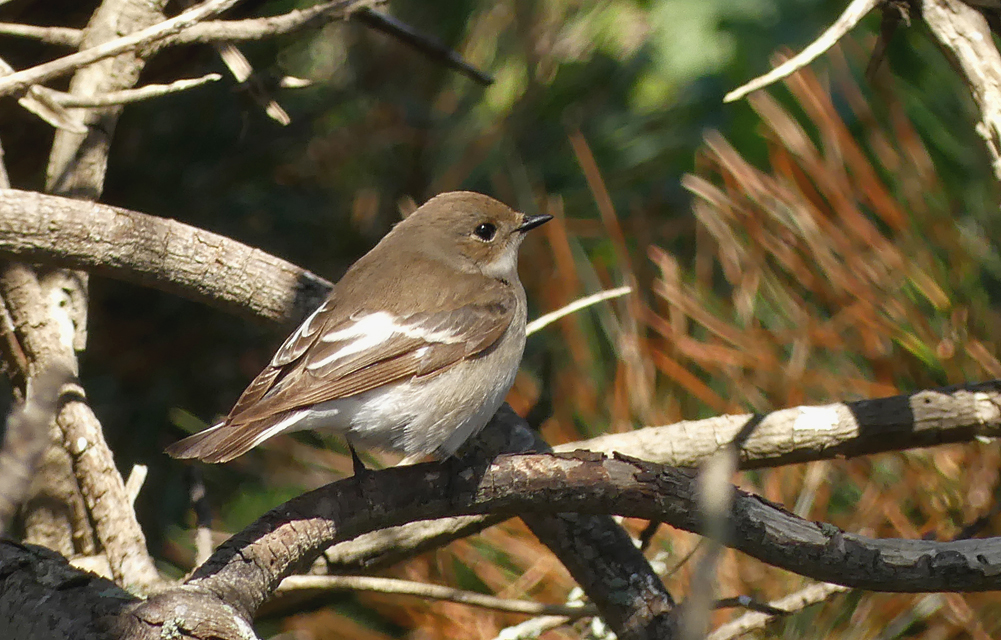
Pied Flycatcher - Fort Hommet, 14 May 19

Pied Flycatcher - Fort Hommet, 14 May 19

Pied Flycatcher - Fort Hommet, 14 May 19

Pied Flycatcher - Fort Hommet, 14 May 19

Coot - Rue des Bergers, 16 May 19

Coot - Rue des Bergers, 16 May 19

Coot - Rue des Bergers, 16 May 19

Coot - Rue des Bergers, 16 May 19

Sedge Warbler - Rue des Bergers, 16 May 19

Sedge Warbler - Rue des Bergers, 16 May 19

Kestrel - Fort Hommet, 7 May 19

Kestrel - Fort Hommet, 7 May 19

Saturday 4th May 2019

After the trip to Spain, birding during the rest of April was pretty tame stuff. Out with the family on 19th we had a very loud Cuckoo calling from the gardens round Fort Saumarez. It was very close but totally invisible. On 22nd April I went up for a quick visit to Pleinmont. An excellent date for migrants one would have thought but it was empty of anything interesting, just my first local Whitethroats of the year. However, the Royal Tern had been reported from Grandes Rocques earlier in the day and I called off on the way home on the off chance it was still there a few hours later. As it usually flies off and never stays anywhere for very long, I was surprised to see it perched on the rocky promontory jutting out from by the slipway. The third year running that I had recorded it on my patch list!

Royal Tern - Grandes Rocques, 22 Apr 19

Royal Tern - Grandes Rocques, 22 Apr 19

The first day back at work after the Easter holidays on 24th was brightened up by a nice Pied Flycatcher in the pines at Fort Hommet, and there was also a splendid group of 11 Bar-tailed Godwits on Vazon beach the same day. Also on Vazon at this time was a very nice concentration of White Wagtails with an estimated 40 birds present on 25th. There was quite a north-westerly blow on 27th and I went for a late morning seawatch at Chouet. A bit of an unusual choice for the spring but I thought there may be the outside chance of a Pom or something surprising. In the end, I totalled just a Razorbill and 3 Manx Shearwaters. On the last day of April I had my first local Reed Warblers of the year singing at the otherwise-quiet Rue des Bergers, and also the second Sedge Warbler I’d found singing at Fort Hommet this spring. Not until 1st May did I have the first Willow Warbler this year which was a very poor show on my part.

Pied Flycatcher - Fort Hommet, 24 Apr 19

Pied Flycatcher - Fort Hommet, 24 Apr 19

Whimbrel - Pulias, 29 Apr 19

Whimbrel - Pulias, 29 Apr 19

On 2nd May I called in briefly into Pulias on the way to work for a quick check but there wasn’t much showing. Just as I was about to leave, a small group of Yellow Wagtails appeared from nowhere and were happily trotting around the stones at the top edge of the vraic pile. The first bird I put my bins on had a very dark cap and I immediately knew it was a GREY-HEADED WAGTAIL, the northern subspecies of Yellow Wagtail or a “thunbergi”. It really was a bolt out of the blue as I was not expecting anything of the sort! Unfortunately, I literally had no time at all to grill the bird as I had to dash off in the car. Another quick check through the bins and I could see that the cap was definitely not black, ruling out a feldegg and the throat was definitely yellow, ruling out an Ashy-headed, and there was no obvious supercilium present. I managed a couple of quick snaps for the record and put out the grapevine message before heading off to work. Although not a full species (therefore not a tick for anyone), this was a rare bird and only the second documented for Guernsey. The date was exactly 9 years after the first - one that me & the Sultans found on the bird race in 2010.

Grey-headed Wagtail - Pulias, 2 May 19

Grey-headed Wagtail - Pulias, 2 May 19

Grey-headed Wagtail - Pulias, 2 May 19

Grey-headed Wagtail - Pulias, 2 May 19

I didn’t even get a chance to have another look at this bird in the evening as there was a silly little parents evening to attend! However many other people had seen the bird during the day and put some better pics online. In the closer photos you can see a thin and broken supercilium present mainly on the right side of the bird and maybe a few specks on the left. I hadn’t even noticed this in the field. This may mean that the bird is a thunbergi from the southern edge of the range in Scandinavia where the northern subspecies meets the central European subspecies flava and some genetic mixing may be happening. Or it may be because the bird is showing remnants of immature or winter plumage. Or it may just be variation within the subspecies - it is not hard to find photos on the net showing thunbergi in its home breeding range with varying amounts of supercilium. Or it may be a mixture of all of these - the variation I suppose is one of the main reasons that these very differing subspecies are unlikely to be split.

The next morning I called at Pulias and tried to see the bird again. I think I remember seeing it briefly fly past but I didn’t get a good look this time either. There were still Yellow Wagtails on the beach and a different bird caught my eye. This bird was a Blue-headed Wagtail type bird with a strong white supercilium and cheek smudge. The blue colour was not very intense and had a greenish wash to it and I thought that this might be a “Channel” Wagtail which is an integrade between the flavissima and flava subspecies. The Yellow Wags certainly are a complex creed.

“Channel”-type Wagtail - Pulias, 3 May 19

“Channel”-type Wagtail - Pulias, 3 May 19

Finally after work on 3rd May I managed to get back to the beach and see the bird again. In the sun from some angles the head could definitely have a bluish tint to it. Another feature which is typical of thunbergi was the ‘necklace’ of green spots across the yellow breast which is rarely shown by the western European subspecies. It never managed to come close enough for detailed photos, but it probably would have done if I’d have been able to wait longer.

Grey-headed Wagtail - Pulias, 3 May 19

Grey-headed Wagtail - Pulias, 3 May 19

Grey-headed Wagtail - Pulias, 3 May 19

Grey-headed Wagtail - Pulias, 3 May 19

Grey-headed Wagtail - Pulias, 3 May 19

Grey-headed Wagtail - Pulias, 3 May 19

Grey-headed Wagtail - Pulias, 3 May 19

Grey-headed Wagtail - Pulias, 3 May 19

Grey-headed Wagtail - Pulias, 3 May 19

Grey-headed Wagtail - Pulias, 3 May 19

Grey-headed and “Channel” Wagtail - Pulias, 3 May 19

Grey-headed and “Channel” Wagtail - Pulias, 3 May 19

There was even variation amongst the normal Yellow Wagtails, the bird shown below was very pale indeed without the bright intensity of the other males, and very faint greenish head markings. It also had a bit more grey-toned back. It certainly stood out.

Yellow Wagtails - Pulias, 3 May 19

Yellow Wagtails - Pulias, 3 May 19

White Wagtail - Pulias, 3 May 19

White Wagtail - Pulias, 3 May 19

Vraic piled up at Pulias where the wagtails congregated - May 19

Vraic piled up at Pulias where the wagtails congregated - May 19

Grey Heron - Pulias, 3 May 19

Grey Heron - Pulias, 3 May 19

Painted Nomad Bee - Lihou Headland, 19 Apr 19

Painted Nomad Bee - Lihou Headland, 19 Apr 19

Hister quadrimaculatus - garden, 21 Apr 19 - a new species of beetle for me.

Hister quadrimaculatus - garden, 21 Apr 19 - a new species of beetle for me.

One thing we did for the first time during the Easter holidays was take a walk up to the top of Victoria Tower which overlooks town. You can collect a key from Candie and take a look across St. Peter Port. Aidan certainly enjoyed it.

Victoria Tower

Victoria Tower

Candie Cemetery from Victoria Tower, Apr 19

Candie Cemetery from Victoria Tower, Apr 19

Elizabeth College from Victoria Tower, Apr 19

Elizabeth College from Victoria Tower, Apr 19

Descending the tower steps

Descending the tower steps