Review of 2019
/STATS
So this is my 2019 review, with the important stats listed below. The main landmark that I hit was 800 species for my world life list but this was cruelly taken away from me by the taxonomists when they lumped Barbary Falcon later in the year - yah boo! Locally, despite a couple of quality days, the overall birding was below average on balance. The number of rarities that turned up was low compared to recent years and a few of the best ones were just not gettable. Nevertheless, personally finding three local rarities was decent form, but all three were species I’ve already found previously. Only one new Guernsey lifer (G W Egret) was well down on the last couple of years when I suppose I have been a little spoiled. A brief trip to Yorkshire to see the family in October brought me an unexpected British tick with an Isabelline Wheatear that I jammed into. Also, I added Falcated Teal to my British List which I saw way back in the 1980’s, now finally accepted onto the British List - a tick over 30 years in the making. The BUBO lads had a superb short-break in central Spain, covering numerous habitats and locations, and I had more-than-expected success with new species. A total of ten new birds in the 5 days there, including all of my serious target species. With non-avian wildlife I thought that I did pretty well in 2019 with almost 100 new ‘pan-species’ ticks - all found locally bar two - despite not really having much time with the microscope this year, mainly due to home improvements getting in the way. Despite having at least 5 new species for the garden in the moth trap, none of these were actually ticks for me.
Picking out the top three wildlife moments for 2019 I’d have to choose;
A) the excitement of actually clearly seeing a Dupont’s Lark in Spain, out in the open, on the ground, something that I presumed would never happen and I had already resigned myself to a heard-only tick;
B) the superb September morning at Pleinmont when there were grounded migrants everywhere and I had 8 species of raptor in just a couple of hours;
C) also at Pleinmont, in August, when an Ortolan appeared in front of me, followed soon after by a second Ortolan, then not long after that two Fan-tailed Warblers ‘zitting’ like maniacs over our heads, all in the same field!
11 new birds for the World List - Falcated Teal, Black-winged Kite, Spanish Imperial Eagle, Great Bustard, Black Vulture, Rock Sparrow, Western Orphean Warbler, Red Avadavat, Citril Finch, Iberian Green Woodpecker, Dupont’s Lark - now on 799.
2 new birds for Britain (& CI) - Falcated Teal, Isabelline Wheatear - now on 402.
1 new bird for Guernsey - Great White Egret - now on 264.
0 new 'self-found' birds - still 274.
1 new Hommet to Rousse 'patch' bird - Long-tailed Duck, makes 164.
0 new garden birds (in or from) - still 89.
2019 Guernsey year list total - 143 - seventh best total.
Official local rarities found - 3 - Grey-headed Wagtail, Fan-tailed Warbler, Long-tailed Duck.
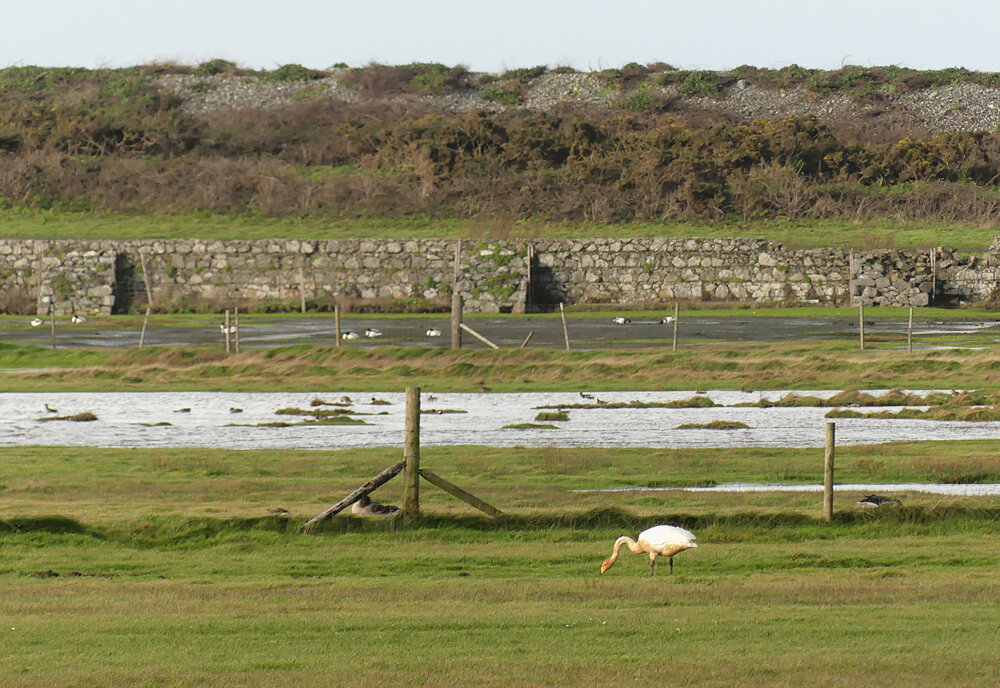
Official local rare species seen - 9 - Whooper Swan, Canada Goose, Long-tailed Duck, Great White Egret, Spotted Redshank, Royal Tern, Grey-headed Wagtail, Fan-tailed Warbler, Cirl Bunting.
End-of-year British Pan-species list - 2758, (new species during year - 91).
End-of-year Guernsey Pan-species list - 2280, (new species during year - 89).
Garden moth list - 648.
New Lepidoptera in Guernsey - 1 - Large Tortoiseshell.
New Lepidoptera in UK - 1 - Juniper Carpet.
My “Patchwork Challenge” points total for this year was quite average, with 135 - just missing the target. It’s notable that along my allocated stretch of coastline, there’s only been 1 point difference in the last three years, with 135 then 136 then 135 again, which means that the 2020 target is easily calculated to be 136 (average of last three years). The bright pink line on the graph below shows quite an up and down year for the patch, with lagging way behind in the early spring before racing ahead by late May resulting in my second best summer total. The poor early autumn though meant that there wasn’t the usual post-summer spike and I feared it was going to be another infamous 2015 season. However, it rallied a bit later on in the autumn and I reached a respectable point score. Species-wise it was 102 which is my second-lowest and I missed some surprising sitters eg Whinchat.


PHOTOS
As in the previous year, I didn’t spend a massive amount of time trying to get quality photos, it was mostly just snapping at what I’ve seen. So many pictures could have been better, but I suppose I foolishly compare my photos to those taken by others with four-figure lenses as big as an arm. However, last year I have picked up a few more useful processing techniques that I’ve started to use, which have been more than useful. Here’s my choice of, not necessarily the best, but definitely my favourite 20 photos of 2019, in chronological order.
1) Lunar eclipse, January - Strangely, Anais never gets up in the night nowadays, but on 21st January she decided to get me up at 4 am the little tinker. This was weird as it was the night of the lunar eclipse and she hasn’t done it since - coincidence? In the end I was pleased to have been woken and since I was up and about, and the clouds were patchy, I tried to get some photos of the event. Previous attempts at night sky photography have been terrible but with persistence, and clearly fluking a decent camera setting, I managed some nice pics which I cobbled together to make a series.

2) Garganey, Rue des Bergers, April - A pair of Garganey appeared on the pond at RDB and so I popped down to have a look. I was pleased that they were showing very well and that they weren’t asleep in the far corner. I started snapping and the birds came closer and closer until they were swimming right in front of the hide window, and I had to zoom out to get the full bird in. Just seeing a wild bird so close was fantastic, especially a scarce species like Garganey, and despite the harsh spring sunshine I managed a few sharp shots, although this was difficult as they were constantly feeding and swimming. In the strong light, the bluish colours didn’t stand out so much but the reddish colours did. The deep red bill of the male is surprising, as I always thought the bills were black, and the powder-snow eyebrow is particularly dramatic.

3) Roller, Santa Marta de Magasca, Spain, April - The open plateau above the village of SMdeM was a very wide open space and any birds seen there would presumably be far away. However, the line of telegraph poles that followed the road was very convenient, especially since nearly every one had a nest box attached. We did see a few Rollers perched up on the wires but it was difficult to get super sharp shots due to the slightly too-far distance and the heat haze. However, I did manage to get one bird just as it was landing after a little swoop and since it was so bright the camera was already on a super fast shutter speed. I wouldn’t usually include a pic of a bird when you can’t see its head but this one was caught in almost a perfectly symmetrical pose, showing off it’s colours and patterns, I just loved how it looked. It was not big enough in the frame to isolate the bird but the wires and weathered wood of the pole in the harsh light also add something to the pic.

4) Plasenzuela Church, Spain, April - Second morning in Spain and I was out first, waiting for the others by the car and there was not a soul in sight. As you can see, it wasn’t exactly first light but, since this was a sleepy Spanish town, no one was about yet. Taken on my phone, I liked the colours in this photo, the bright, dappled sky, the plump oranges. If only I had been a few minutes earlier when there was a Hoopoe singing from the weather vane on top.

5) Black-shouldered Kite, Saucedilla, Spain, April - After finding these birds across a field, we clearly weren’t going to get close photos, so it was just a “record shot” situation. But just because something is going to just be a record shot, it doesn’t mean you can’t make it into a nice photo with a little thought. Initially the bird was perched on an ordinary bush and I thought that it would be nicer if it moved onto the dead tree just to the left, which it soon did. It’s natural then to just get the bird in the middle of the frame and snap a few distant snaps, but I thought it would look a lot nicer if the whole tree was in the picture, resulting in a pleasant “bird in habitat” shot. The bluish, cloudy “sky” in the background is actually a distant hillside.

6) Saucedilla, Spain, April - Just a phone-photo to show the habitat of the Black-shouldered Kites. Really liked the way it turned out with the green shades of the grass almost wave-like in the breeze and the line of trees and distant mountains - the tree on the above photo is just visible on the left. It could almost look like natural rolling grassland until you notice the lines in the grass showing it is actually a planted crop, plus the tower and the telegraph wires in the distance. And that tree on the right is a beauty!

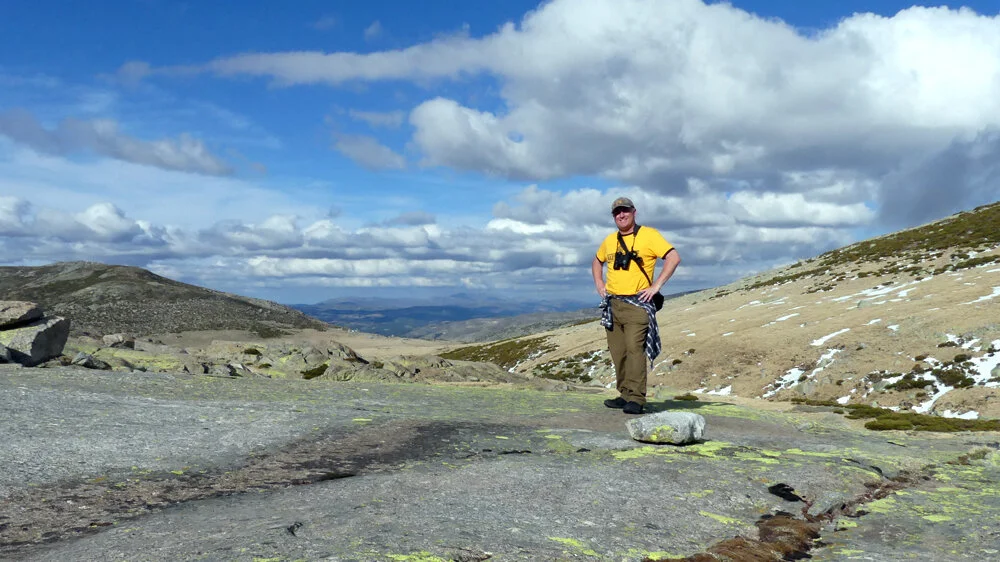
7) Plataforma de Gredos, Spain, April - Not really ideal to have myself in a favourite photo but it clearly shows how much I’ve enjoyed my hike up to the tops of the sierra. Both Spain and the sky are rushing away from the camera into the far distance. I find it so exciting going up mountains when I go off-island. The nearest thing to scaling a mountain here in Guernsey is when we drive up to the airport!
8) Spanish Ibex, Plataforma de Gredos, Spain, April - With a close head shot like this it could almost be a pic taken of a goat on a farm, rather than a wild mammal. This photo really shows the power of processing as it was so dark and grey when I took this that the final result is almost unrecognisable from the seemingly unusable original photo. I was not going to process this one at all it looked so unpromising on the screen. This was one of a small group of ibex that crossed the path in front of us as we descended in the evening when the sun had already gone behind the mountainside. This one just stopped briefly to look back at us and I think I managed to catch it fully head-on and symmetrical. The last of the sun has highlighted the fluffy bits and I also like the black and yellow lichen speckled rocks behind.

9) Black-eared Wheatear, Sepulveda, Spain, April - Practically the final photograph I took in Spain and it was of this terrific bird. After seeing the Dupont’s we had a short time to wander round the area and this male WBEW decided to start singing from a tree. I just kept snapping then stalking, snapping then walking, until I managed to get really close. I could have chosen any one of a few pics of this bird, perched up nicely on a curved branch of a spiky shrub. If rumours are true, then this subspecies might actually get promoted to a lifer!

10) Le Gouffre, May - Despite living here for more than 20 years, there are still a handful of spots along the coast that are still unfamiliar. Although I have been to Le Gouffre many times, I’d never walked down the steps to the moorings. I found it a splendid, sleepy little spot with nature and human activity living side by side (I suppose it helps when the human activity is very infrequent). I took various pics here but this was my favourite, with the wild flowers surrounding the top of the old, weather-beaten slipway, which disappears into the sea and the boat just fits in the frame nicely in the corner. This slipway is so steep, I could imagine kids using it as some kind of sledging slope in the summer.

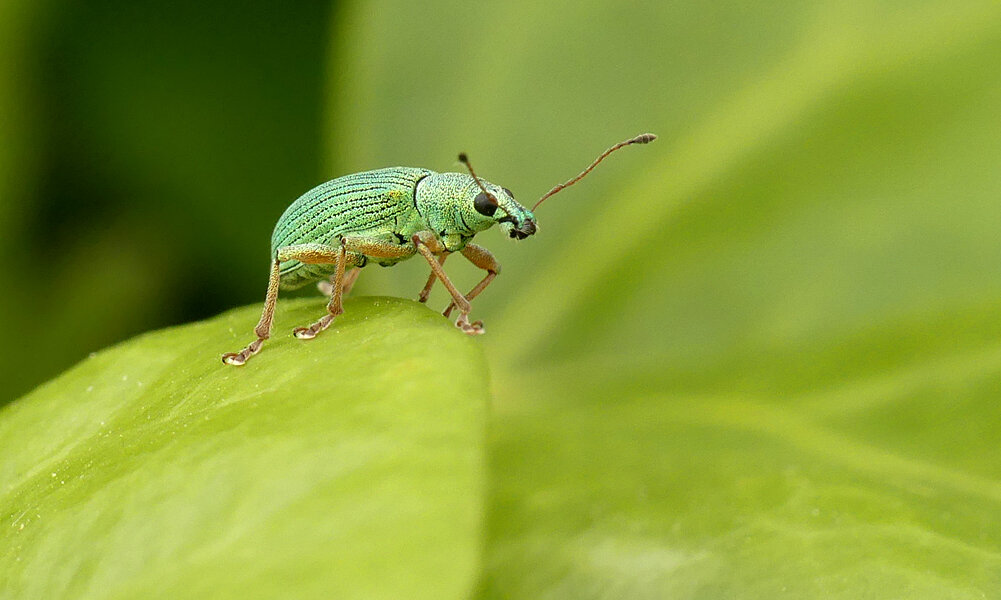
11) Polydrusus formosus, Le Gouffre, May - When taking photos of insects it can often result in a dead-eyed image with the subject just standing awkwardly and motionless. It is always nice to get a pic when it looks like the creature is actually doing something and there is the illusion of movement. This little weevil looks like it has just reached the edge of the leaf and is looking around as to where to go next with an inquisitive expression. Since the weevil isn’t too massive in the frame, almost all the body is sharp, whilst almost all the surrounding vegetation is in pleasing soft, green focus.
12) Bright Wave, garden, June - A simple portrait pic of a new species for the garden and only my second ever sighting. The moth is very fresh and shows no damage and, like most geometers, being very flat makes focussing not a problem. I often use the grapevine leaves that grow in the back garden as a background for moths. They are a nice bright green, with decent texture and more importantly, they are dull rather than shiny.

13) Large Tortoiseshell, Vale, July - very rarely have I twitched a butterfly but this rare species that kept returning to the same garden a few days in a row brought me out. We had to wait a while and I was just about to give up when it suddenly flew in and was quite content feeding on the valerian right in front of us. I took a great many photos and this was one of many I could have included showing fully-spread wings. A new species for me.

14) Light Bulb Sea Squirts, Port Soif, July - I’ve found it so difficult to get decent photos of rockpool creatures without taking them out their habitat and putting them into a tray first which looks very artificial. So I was very lucky with these weird little jellies that I managed a focussed shot whilst they were still under the sea, despite getting a few spots of light flare as the water surface rippled. They usually are found on the underside of rocks but I managed to prop a rock on its side a bit so I could take the photo. The strange Tron-like lines are showing nicely and you can also see the internal structures on some of them. There’s so much rockpool creatures that I haven’t seen before, I need to get my wellies on more often.

15) Privet Hawk Moth, Baubigny, August - Despite looking for wildlife literally constantly, I never seem to bump into hawk moth larvae. We used to have pine trees in the garden and had Pine Hawk Moths breeding every year but since then I can’t remember seeing any. So it was a big surprise to see this huge beastie right out in the open feeding on a wayfaring tree planted near St. Sampsons High School near home. I took lots of pics but this was one of my favourites as it was holding on to a twig by its clasping false back legs and the front of the body was jutting out at 90 degrees. The green colour of the body is almost translucent and gives the impression it is slightly glowing. With the little finger-like legs all bunched next to its ‘chin’ it looks like it is plotting an evil plan! It really is a chunky old chap.

16) Painted Lady, garden, August - We left one of the self-seeded Buddleja weeds to grow into a massive bush this year especially to attract butterflies. And it certainly did with 5 or 6 Painted Lady at once during the mini-influx of the species in the autumn. I have many, many pictures of Painted Lady which are either from above with spread wings or the underwings from the side. So it was nice to get a picture from an unusual angle, dead square front on. Looking closely, this individual is actually tatty so it is probably the best angle. I’ve never noticed the stripes on the face before which frame the drooping tongue nicely. The plain background and purple triangle of flowers makes a pleasing composition.

17) Great White Egret, Vale Pond, September - As an island bogey bird for me I was pleased to rush out of the house one evening to tick off Great White Egret after a couple of near misses for the species. It was quite dusk-like from the hide and the two egrets were not exactly close, so it would be very difficult to get sharp pictures in the gloom. However, I managed one or two atmospheric shots of the birds against the water which had started to reflect the slightly pinkish evening sky. The one below has the bird slightly fuzzy but it is a nice composition with its disappearing reflection and the trio of black stones sticking out of the water. Full disclosure for this shot - I did remove one or two sticks and unhelpful ripples using the computer.

18) Tebenna micalis, garden, October - A tiny little moth which is usually an immigrant from the continent was found on the window outside one evening. I brought it inside for some photos as it was a striking little critter, with shiny silver lines plus tiny lilac-coloured dots on the wings. Unfortunately it flew off straight away but I followed it as it hovered round the front room. It found a spot to rest on the wooden beam across the ceiling and, by climbing on a chair and holding the camera at arms length, I managed a few close-up shots before I caught and released it. Due to the difficult conditions I could not get a single fully in-focus image so the photo below is actually achieved using photo-stacking software on two different pics. This doesn’t usually work very well for hand held shots but I was lucky in this case.

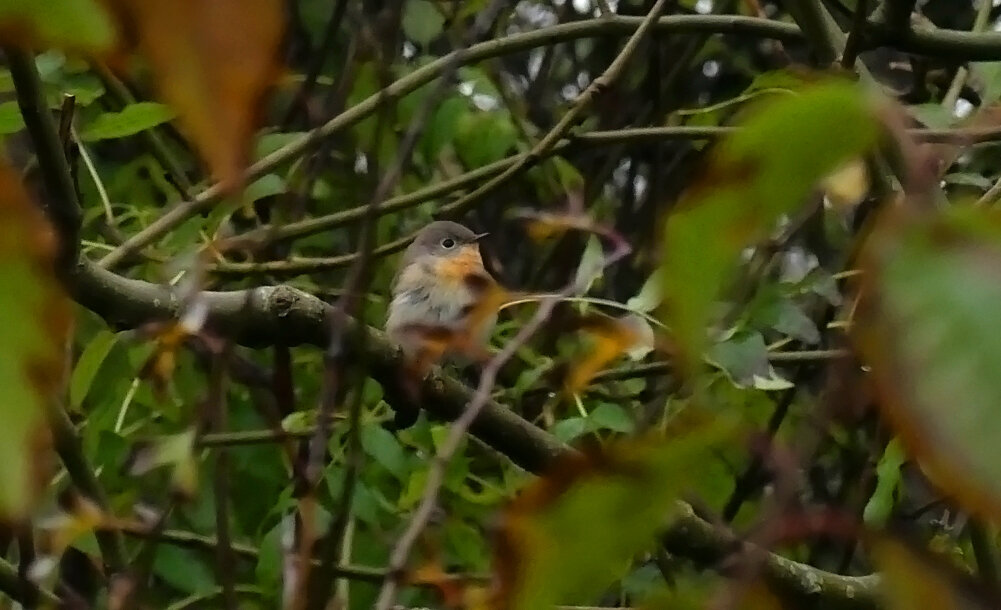
19) Red-breasted Flycatcher, Flamborough, November - I realise that is definitely not a good photo - in fact most photographers would scoff, as it is a very poor photo. But to me, this is a ‘birders’ photo’. It’s late autumn, the weather is grotty, you haven’t seen anything all day, and then, peering through the tree branches, you see a cracking rare bird in front of you. I reckon it catches the essence of rare bird finding. (not that I found this bird though - but you get my point!). Also it was my first ever red-breasted Red-breasted Flycatcher after all these years birding.
20) Snow Bunting, Pleinmont, November - these recently-arrived Snow Bunts from the Arctic and their typical tame-ness are a photographer’s open-goal. There were two birds feeding amongst the muddy puddles at the scramble track and, despite the poor light levels, I managed quite a few nice shots. If I had proper commitment to photography, I would have lied down in the mud and got even better pics but I didn’t fancy that! I think this one is probably a male bird due to the whitish face and grey cast to the back. When it was feeding next to a puddle it made a better picture than many of the others which just had a mucky brown muddy background. I also like its stance, showing off its stripy bits to the camera, but it could’ve at least washed its bill for me!